
Restaking lets you reuse already-staked ETH to secure additional protocols beyond Ethereum’s base layer, earning extra yield without unstaking. EigenLayer pioneered this model by creating a shared security marketplace where stakers opt into Actively Validated Services. The trade-off is real: restaking compounds slashing risk across every service you validate, and smart contract bugs in the middleware layer could drain your stake entirely.
In This Article
What Is Restaking and Why Does It Exist?
Restaking is the process of taking ETH that already secures the Ethereum network and pledging it to secure additional decentralized services simultaneously. Instead of each new protocol bootstrapping its own validator set from scratch, restaking lets them borrow Ethereum’s existing security.
The problem restaking solves is economic. Building a new oracle network, bridge, or data availability layer requires convincing validators to lock capital specifically for that protocol. EigenLayer’s documentation describes this as “fragmented security” — billions in staked ETH sitting idle while new protocols struggle to attract even modest economic security. Restaking pools that idle capital toward productive use.
According to DefiLlama, total restaked value across all protocols exceeded $15 billion at its peak. That capital secures dozens of services that would otherwise need their own staking economies. For a deeper look at how standard staking works before adding the restaking layer, read our crypto staking guide for beginners.
How Does EigenLayer Work?
EigenLayer operates as a set of smart contracts on Ethereum that sit between stakers and the services requesting security. The architecture has three participants: restakers who provide capital, operators who run validation software, and Actively Validated Services (AVSs) that consume the security.
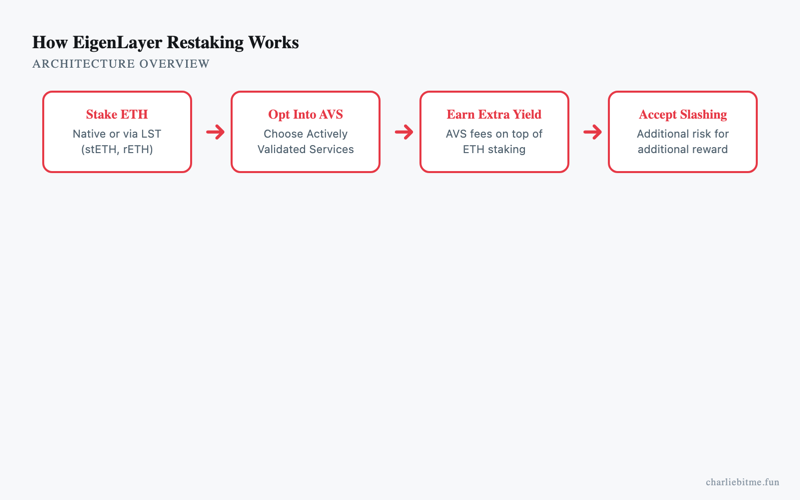
The flow works like this: a staker deposits ETH or liquid staking tokens (like stETH from Lido or rETH from Rocket Pool) into EigenLayer’s contracts. They then delegate to an operator — a node runner who registers to validate specific AVSs. The operator runs the required software for each AVS and earns rewards, which flow back to the staker minus a commission.
EigenLayer introduced the concept of “programmatic slashing.” Each AVS defines its own slashing conditions. If an operator misbehaves while validating an AVS — for example, signing conflicting messages on an oracle service — the AVS can slash a portion of the operator’s delegated stake. This is what gives the security model teeth.
EigenDA is the most prominent AVS, providing data availability services to rollups. According to EigenLayer’s documentation, EigenDA processes data at a fraction of the cost of posting directly to Ethereum’s calldata, making it attractive to L2 chains looking to reduce fees.
What Are the Main Risks of Restaking?
Restaking introduces compounding risk that does not exist in vanilla Ethereum staking. The primary dangers are slashing cascades, smart contract vulnerabilities, and operator concentration.
Slashing risk multiplies with each AVS an operator validates. A single operator validating five AVSs faces five independent slashing conditions. If one AVS has a bug in its slashing logic, it could trigger penalties that affect capital pledged to other services. Vitalik Buterin published a blog post warning that restaking could create systemic risk for Ethereum if the total restaked capital grows large enough relative to ETH’s market cap.
| Risk Type | Source | Severity | Mitigation |
|---|---|---|---|
| Slashing cascade | Multiple AVS penalties hitting simultaneously | High | Limit AVS exposure per operator |
| Smart contract bug | EigenLayer or AVS contract vulnerability | High | Use audited contracts, limit deposits |
| Operator misconduct | Operator runs faulty or malicious software | Medium | Delegate to reputable, diversified operators |
| Liquidity risk | Withdrawal delays during high-demand periods | Medium | Keep reserves outside restaking |
| Regulatory uncertainty | Restaking yields classified as securities income | Low-Medium | Consult a tax professional |
Smart contract risk is the silent danger. EigenLayer’s core contracts have been audited by firms including Sigma Prime and ConsenSys Diligence, but the AVS contracts are maintained by their own teams. A vulnerability in any single AVS contract could expose restaked capital. Read our methodology at How We Research for how we verify protocol claims.
How Does Restaking Compare to Liquid Staking?
Liquid staking and restaking solve different problems. Liquid staking gives you a tradeable token representing your staked ETH, solving the liquidity problem. Restaking takes that staked ETH and puts it to work securing additional services, solving the capital efficiency problem.
They are complementary, not competing. Most restakers deposit liquid staking tokens — stETH, rETH, cbETH — into EigenLayer rather than native ETH. This means they earn Ethereum staking rewards, liquid staking protocol rewards, and restaking rewards simultaneously. The yield stacks, but so does the risk.
Liquid restaking protocols like Ether.fi, Puffer Finance, and Renzo have emerged to add yet another layer. They accept deposits, restake through EigenLayer, and issue a liquid restaking token (LRT) that trades freely. According to DefiLlama data, Ether.fi alone held over $5 billion in total value locked at its peak, making it one of the largest DeFi protocols by TVL.
Who Competes with EigenLayer?
EigenLayer was first, but the restaking market now includes credible competitors with different architectural choices.
Symbiotic, backed by Paradigm and Lido co-founders, launched with a permissionless design where any ERC-20 token can serve as collateral — not just ETH derivatives. This broadens the restaking concept beyond Ethereum’s validator set. Symbiotic’s documentation emphasizes modularity: networks choose their own collateral types, slashing conditions, and reward structures.
Karak takes a multi-chain approach. It supports restaking across Ethereum, Arbitrum, and other chains, and accepts a wider range of assets including stablecoins. According to Karak’s documentation, this lets protocols buy security denominated in the asset type that best matches their risk profile.
My view: EigenLayer’s first-mover advantage and the depth of its AVS ecosystem make it the default choice for most restakers today. But Symbiotic’s permissionless collateral model is architecturally more flexible, and competition will ultimately benefit stakers through better terms and more innovation.
How Do You Start Restaking on EigenLayer?
The process requires an Ethereum wallet with either native ETH or a supported liquid staking token. EigenLayer’s app at app.eigenlayer.xyz handles deposits directly.
For native restaking, you need to run your own Ethereum validator and point its withdrawal credentials to EigenLayer’s contracts. This path is for technical operators comfortable managing validator infrastructure.
For liquid restaking — the more accessible route — deposit stETH, rETH, cbETH, or another supported LST into EigenLayer’s strategy contracts. Then delegate to an operator whose AVS selection and track record you trust. Review operator performance on the EigenLayer dashboard before delegating. Cross-chain operations like bridging assets between blockchains may be needed if your tokens are on a different network.
Liquid restaking protocols (Ether.fi, Renzo, Puffer) simplify this further. Deposit ETH, receive an LRT, and the protocol handles operator selection and AVS management. The trade-off is an additional smart contract layer and protocol fees.
Frequently Asked Questions
- Can you lose your staked ETH through restaking?
- Yes. If an operator you delegate to gets slashed by an AVS, a portion of your restaked capital can be penalized. The amount depends on the AVS’s slashing conditions and the severity of the violation. This risk is in addition to standard Ethereum slashing for validator misbehavior.
- What yield can you expect from restaking?
- Restaking yields vary by AVS and market conditions. When I last checked, EigenLayer restakers earned Ethereum staking rewards (roughly 3-4% APR) plus AVS-specific rewards that varied from 1-8% depending on the service and demand. These figures change frequently as new AVSs launch and reward programs adjust.
- Is restaking available outside of Ethereum?
- Karak supports restaking across Ethereum, Arbitrum, and other EVM chains. Babylon Protocol enables Bitcoin restaking, letting BTC holders secure proof-of-stake chains. Solana restaking through protocols like Solayer is also emerging.
- Do restaking rewards create a tax liability?
- In the United States, restaking rewards are likely taxable as ordinary income when received, similar to staking rewards. The IRS has not issued specific guidance on restaking, but the general principle of income recognition applies. Consult a qualified tax professional for your situation.
This article is for informational purposes only and does not constitute financial advice. Cryptocurrency restaking involves significant risk including total loss of staked capital. Consult a qualified financial advisor before making investment decisions.
Sources
- EigenLayer Documentation — Protocol architecture and AVS framework (checked August 2026)
- DefiLlama — EigenLayer TVL — Total value locked data (checked August 2026)
- Symbiotic Documentation — Permissionless restaking architecture (checked August 2026)
- Karak Documentation — Multi-chain restaking protocol (checked August 2026)
- Vitalik Buterin’s Blog — Overloading Ethereum consensus risks (checked August 2026)