Wrapped tokens are cryptocurrency assets pegged 1:1 to another token but deployed on a different blockchain, enabling cross-chain use of assets that would otherwise be locked to their native network. WBTC (Wrapped Bitcoin) on Ethereum is the most prominent example — it lets Bitcoin holders access Ethereum’s DeFi ecosystem without selling their BTC. This guide explains the wrapping mechanism, major wrapped tokens, custodial versus trustless approaches, and the risks you should understand.
In This Article
Wrapped tokens are one piece of the broader interoperability puzzle. If you are exploring how to move assets between chains, our guide on bridging crypto between blockchains covers the infrastructure. Wrapped tokens and bridges are closely related — many bridges produce wrapped tokens as their output.
How Does the Token Wrapping Mechanism Work?
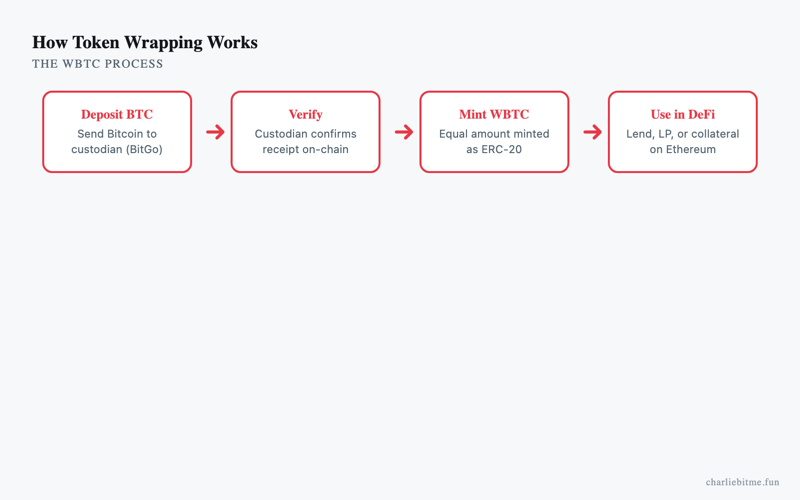
Token wrapping involves locking the original asset with a custodian or smart contract, then minting an equivalent wrapped token on the target blockchain. The wrapped token maintains a 1:1 peg because every wrapped token in circulation has a corresponding locked original token backing it. When you redeem, the wrapped token is burned and the original is unlocked.
The process for WBTC, managed by BitGo and the WBTC DAO, works like this: a merchant (authorized intermediary) sends BTC to a custodian (BitGo). BitGo locks the BTC and mints an equal amount of WBTC as an ERC-20 token on Ethereum. The total BTC in custody is publicly verifiable on-chain.
This is fundamentally a trust model. You trust that the custodian will always hold enough BTC to cover every WBTC in circulation. The on-chain proof of reserves addresses this to some extent, but it requires ongoing verification.
What Are the Most Important Wrapped Tokens?
WBTC, WETH, and stETH are the three most important wrapped or derivative tokens by market cap and DeFi usage. Each serves a distinct purpose in the ecosystem and has different trust assumptions.
| Token | Original Asset | Target Chain | Custodian | Trust Model | TVL |
|---|---|---|---|---|---|
| WBTC | Bitcoin (BTC) | Ethereum | BitGo / WBTC DAO | Centralized custodian | ~$10B when I last checked |
| WETH | Ether (ETH) | Ethereum (ERC-20 version) | Smart contract | Trustless | Integrated into most DEXs |
| stETH | Staked ETH | Ethereum | Lido DAO | Protocol-governed | ~$15B when I last checked |
| cbBTC | Bitcoin (BTC) | Ethereum, Base | Coinbase | Centralized (Coinbase custody) | Growing |
| tBTC | Bitcoin (BTC) | Ethereum | Threshold Network | Decentralized threshold signatures | Smaller than WBTC |
WETH is unique because it wraps ETH on its own chain. Ethereum’s native ETH does not conform to the ERC-20 standard, so many DeFi protocols require WETH for compatibility. The wrapping is handled by a simple smart contract — deposit ETH, receive WETH. It is trustless and instant.
What Is the Difference Between Custodial and Trustless Wrapped Tokens?
Custodial wrapped tokens (WBTC, cbBTC) rely on a centralized entity to hold the backing assets, while trustless wrapped tokens (tBTC, renBTC before it shut down) use decentralized cryptographic protocols to manage custody. The choice determines your counterparty risk.
BitGo, the custodian behind WBTC, is a regulated digital asset custodian. According to their WBTC dashboard, on-chain proof of reserves shows the BTC backing in real time. However, regulatory action against BitGo, a security breach, or a governance dispute within the WBTC DAO could theoretically affect the peg.
Trustless alternatives like Threshold Network’s tBTC use threshold cryptography — the private key controlling the locked Bitcoin is split among many independent node operators. No single party can steal or freeze the funds. The tradeoff is lower liquidity and less DeFi integration compared to WBTC.
My opinion: for most users, WBTC through established DeFi protocols is the practical choice because of its deep liquidity. But if you are holding significant amounts long-term, the centralization risk of WBTC is worth taking seriously. Diversifying between WBTC and a trustless alternative like tBTC reduces single-custodian risk.
What Are the Main Use Cases for Wrapped Tokens in DeFi?
Wrapped tokens unlock three primary use cases: lending and borrowing Bitcoin on Ethereum, providing liquidity in cross-chain trading pools, and using BTC as collateral for stablecoin loans. Without wrapping, Bitcoin holders are locked out of Ethereum’s DeFi ecosystem entirely.
On Aave, you can deposit WBTC as collateral and borrow stablecoins against it — accessing liquidity without selling your Bitcoin exposure. On Uniswap and Curve, WBTC liquidity pools enable decentralized trading between BTC-backed assets and other tokens. For those also exploring yield opportunities, liquid staking and wrapped tokens share the concept of unlocking trapped capital.
Understanding wrapped tokens also matters for your overall crypto staking strategy, since many staking derivatives (stETH, rETH) function similarly to wrapped tokens and can be used in the same DeFi protocols.
What Are the Risks of Holding Wrapped Tokens?
The three main risks are custodian failure (for centralized wrappers), smart contract bugs in the wrapping contract, and de-pegging events where the wrapped token trades below the value of the underlying asset. All three have occurred in practice.
stETH briefly de-pegged to ~0.93 ETH during the Three Arrows Capital collapse in 2022. While it recovered, holders who sold during the de-peg realized a loss. WBTC has maintained its peg more consistently, but the risk exists. If the custodian were compromised, WBTC could theoretically become worthless overnight.
Always verify the backing of any wrapped token you hold. For WBTC, check the proof of reserves dashboard. For liquid staking tokens, verify the withdrawal queue and protocol health. Our research methodology covers how we verify these claims.
Frequently Asked Questions
- Is WBTC the same as Bitcoin?
- No. WBTC is an ERC-20 token on Ethereum backed 1:1 by Bitcoin held in custody. It tracks Bitcoin’s price but carries additional risks (custodian risk, smart contract risk) that native BTC does not have. You cannot use WBTC on the Bitcoin network.
- Can I unwrap WBTC back to regular Bitcoin?
- Yes, through a WBTC merchant. The process typically takes a few hours. You burn WBTC and receive BTC at the Bitcoin address you specify. Some exchanges also allow direct WBTC-to-BTC conversion.
- Is wrapping or unwrapping a taxable event?
- The IRS has not issued specific guidance. Most tax professionals treat wrapping (BTC to WBTC) as a non-taxable event since you receive an asset of equal value. However, using WBTC in DeFi (lending, swapping) triggers separate taxable events.
Sources
- WBTC Network — Proof of Reserves Dashboard — accessed when I last checked
- Threshold Network — tBTC Documentation — accessed when I last checked
- DefiLlama — TVL and Protocol Data — accessed when I last checked
- Chainlink CCIP — Cross-Chain Protocol — accessed when I last checked
This article is for informational purposes only and does not constitute financial advice. Cryptocurrency investments carry significant risk. Consult a qualified financial advisor before making investment decisions.