Bridging crypto means transferring tokens from one blockchain to another using a cross-chain bridge protocol. Bridges lock your tokens on the source chain and mint equivalent tokens on the destination chain, letting you use assets like ETH on networks such as Arbitrum, Solana, or Polygon. This guide covers how bridges work, the main types, security risks, and a step-by-step walkthrough for completing your first bridge transfer.
In This Article
Cross-chain bridging solves a fundamental problem: blockchains do not natively communicate with each other. Your Ethereum cannot simply appear on Solana without an intermediary. Understanding bridges is essential if you participate in DeFi across multiple chains, and it connects directly to how you stake assets across different networks.
How Do Crypto Bridges Actually Work?
A crypto bridge locks tokens in a smart contract on the source chain and mints corresponding wrapped or synthetic tokens on the destination chain. When you bridge back, the destination tokens are burned and the original tokens are unlocked. This lock-and-mint mechanism is the most common architecture, though several alternatives exist.
The bridge operator — either a set of validators, a multisig committee, or a decentralized protocol — verifies that the lock transaction happened before authorizing the mint. According to DefiLlama’s bridge tracker, cross-chain bridges collectively process billions of dollars in transfers monthly. The security of the entire operation depends on who controls the verification step.
What Are the Different Types of Crypto Bridges?
The three main bridge architectures are lock-and-mint, burn-and-mint, and liquidity pool bridges. Each makes different tradeoffs between speed, security, and decentralization. The type of bridge determines your risk profile for any given transfer.
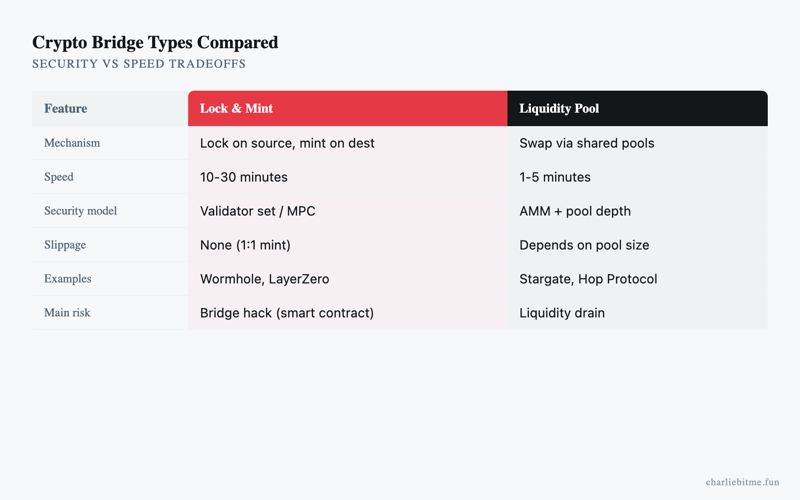
| Bridge Type | How It Works | Speed | Security Model | Example |
|---|---|---|---|---|
| Lock-and-Mint | Locks on source, mints wrapped on destination | 5-30 minutes | Depends on validators/multisig | Wormhole, Portal |
| Burn-and-Mint | Burns on source, mints native on destination | 10-60 minutes | Relies on both chain consensus | CCIP (Chainlink) |
| Liquidity Pool | Swaps via paired liquidity on both chains | 1-10 minutes | Pool depth and smart contract risk | Stargate, Across |
| Atomic Swap | Hash-locked contracts on both chains | Variable | Trustless, no intermediary | THORChain |
Liquidity pool bridges are typically fastest because they do not wait for cross-chain verification — they simply swap from one pool to another. However, large transfers can suffer significant slippage if pool depth is insufficient.
Which Bridges Are the Most Used and Trusted?
Stargate Finance, Across Protocol, and Chainlink CCIP consistently rank among the most-used bridges by volume and have not suffered major exploits. However, no bridge is risk-free. The safest approach is to use the bridge with the highest total value locked for your specific chain pair.
According to DefiLlama, Stargate Finance typically handles over $100 million in daily volume. Across Protocol is known for fast finality on Ethereum Layer 2 transfers. Chainlink CCIP uses Chainlink’s oracle network for verification, which adds a layer of decentralization that most bridges lack.
My opinion: for Ethereum-to-Layer-2 transfers specifically, native bridges offered by the L2 themselves (like Arbitrum’s native bridge or Optimism’s gateway) are the safest choice, even though they are slower. When you control the time, use native bridges. When you need speed, Across Protocol offers the best combination of velocity and security.
What Are the Security Risks of Using Bridges?
Bridge hacks have resulted in over $2.5 billion in losses since 2021, making bridges the single most exploited category in DeFi. The Ronin Bridge lost $625 million, Wormhole lost $320 million, and Nomad lost $190 million. The common thread: centralized control points in the verification mechanism.
Bridges concentrate value in smart contracts that hold locked tokens. This makes them high-value targets. The verification step — confirming that tokens were locked before minting — is where most exploits occur. A compromised validator set or a vulnerability in the verification logic can drain the entire bridge.
If you are staking ETH across different protocols, understand that bridged assets carry the additional risk of the bridge itself on top of the protocol risk. Similarly, liquid staking tokens that are bridged to other chains compound risk layers.
How Do You Bridge Crypto Step by Step?
The process involves connecting your wallet to the bridge interface, selecting source and destination chains, approving the token, and confirming the transaction. Most bridges complete in under 30 minutes, though native bridges from Layer 2 back to Ethereum can take seven days due to the challenge period.
Step 1: Go to the bridge’s official website. Verify the URL carefully — phishing sites impersonate popular bridges. Bookmark the correct URL after your first use.
Step 2: Connect your wallet (MetaMask, Rabby, or Phantom depending on the chains). Select the source chain, destination chain, token, and amount.
Step 3: Approve the token for the bridge contract if this is your first time bridging that token. This is a separate transaction from the bridge itself.
Step 4: Confirm the bridge transaction. You will see the estimated time and fees. Gas fees apply on the source chain. Some bridges also charge a protocol fee of 0.01% to 0.1%.
Step 5: Wait for the bridge to process. Most interfaces show a progress tracker. Once complete, switch your wallet to the destination network to verify the tokens arrived.
Always bridge a small test amount first before sending significant value. Read our research methodology for how we verify the claims in this guide.
How Much Does Bridging Cost?
Bridge costs include gas fees on the source chain, a protocol fee (typically 0.01%-0.3%), and potential slippage for liquidity pool bridges. Total cost for a standard ERC-20 bridge from Ethereum to Arbitrum ranges from $2 to $15 depending on gas prices when I last checked.
Layer 2 native bridges are usually cheapest for large amounts because they charge minimal protocol fees. Liquidity pool bridges like Stargate charge a small fee but execute instantly. The more exotic the chain pair, the higher the cost tends to be due to lower liquidity.
Frequently Asked Questions
- Can you lose crypto when bridging?
- Yes. Bridge exploits have caused billions in losses. Use established bridges with strong security records, verify URLs, and test with small amounts first. Once confirmed on the destination chain, the transfer is complete and safe.
- How long does bridging take?
- Liquidity pool bridges take 1-10 minutes. Lock-and-mint bridges take 5-30 minutes. Native bridges from Layer 2 back to Ethereum mainnet can take up to 7 days due to the challenge period for optimistic rollups.
- Is bridging a taxable event?
- The IRS has not issued specific guidance on bridging. Most tax professionals treat a bridge of the same asset (ETH to ETH on another chain) as non-taxable, similar to transferring between wallets. Bridging to a different token may be treated as a swap.
- What happens if a bridge is hacked after I used it?
- If you already received and moved your tokens on the destination chain, you are generally unaffected. The risk is to tokens still locked in the bridge contract, to liquidity providers, and to users mid-transfer during the exploit.
Sources
- DefiLlama Bridge Volume Tracker — accessed when I last checked
- Across Protocol — accessed when I last checked
- Chainlink CCIP Documentation — accessed when I last checked
- Rekt News — Bridge Exploit Database — accessed when I last checked
This article is for informational purposes only and does not constitute financial advice. Cryptocurrency investments carry significant risk. Consult a qualified financial advisor before making investment decisions.