Impermanent loss occurs when the price of tokens you deposited into a liquidity pool changes relative to each other, causing your position to be worth less than if you had simply held the tokens. The loss is “impermanent” because it reverses if prices return to their original ratio. In practice, permanent divergence is common, making this the primary risk of providing liquidity in decentralized finance.
In This Article
How Does Impermanent Loss Happen?
Automated market makers (AMMs) like Uniswap, Curve, and SushiSwap use a constant product formula to price tokens in a pool. The basic formula is x * y = k, where x and y are the quantities of two tokens and k is a constant. When external market prices move, arbitrage traders rebalance the pool to match, extracting value from liquidity providers (LPs) in the process.
Imagine you deposit $1,000 of ETH and $1,000 of USDC into a 50/50 Uniswap pool — $2,000 total. ETH’s price doubles. Arbitrageurs buy ETH from the pool until the pool price matches the market. Your pool position now contains less ETH and more USDC. The total value of your position is roughly $2,828 — but if you had simply held your original ETH and USDC, you would have $3,000. The $172 difference is impermanent loss.
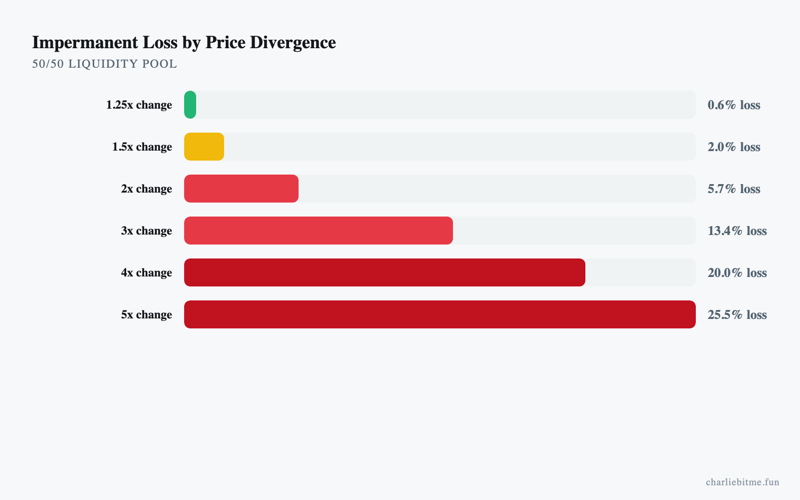
The loss scales with the magnitude of price divergence. A 2x price change produces roughly 5.7% IL. A 5x change produces roughly 25.5%. These numbers come from the mathematical properties of the constant product formula and are consistent regardless of which direction the price moves.
| Price Change | Impermanent Loss | Pool Value vs Hold |
|---|---|---|
| 1.25x (25% up) | 0.6% | 99.4% of hold value |
| 1.5x (50% up) | 2.0% | 98.0% of hold value |
| 2x (100% up) | 5.7% | 94.3% of hold value |
| 3x (200% up) | 13.4% | 86.6% of hold value |
| 5x (400% up) | 25.5% | 74.5% of hold value |
| 10x (900% up) | 42.5% | 57.5% of hold value |
When Is Impermanent Loss Actually Permanent?
The loss becomes permanent the moment you withdraw your liquidity at a different price ratio than when you deposited. If ETH doubled while you were providing liquidity and you withdraw at that point, the 5.7% loss is realized and final. The word “impermanent” in the name is misleading — it only applies if you never withdraw and prices eventually return to the exact original ratio.
In volatile crypto markets, price ratios rarely return to their starting point. Trending markets — where one token consistently outperforms the other — create persistent impermanent loss that trading fees may not offset. According to analysis by Bancor Protocol published in their blog, over 50% of Uniswap v2 liquidity providers were net negative (IL exceeded fee income) during the 2021 bull market.
Pairs involving one stablecoin and one volatile token (ETH/USDC, for example) are particularly exposed. The stablecoin side stays flat while the volatile token moves. Pairs of two correlated assets (ETH/stETH, USDC/DAI) experience minimal impermanent loss because their price ratio stays close to 1:1.
How Do Trading Fees Offset Impermanent Loss?
Liquidity providers earn a share of every trade executed through their pool. On Uniswap v2, LPs earn 0.3% of each trade. On Uniswap v3, fee tiers range from 0.01% to 1%, depending on the pool. The question is whether cumulative fee income exceeds impermanent loss over your holding period.
High-volume pools generate enough fees to offset moderate impermanent loss. The ETH/USDC 0.3% pool on Uniswap consistently generates 15-30% annualized fee income during active market periods, according to data from Uniswap Analytics. If impermanent loss over that period is 5-10%, the LP is still net positive.
Low-volume pools are the trap. A new token pair with thin trading volume generates negligible fees. When the token price inevitably moves, impermanent loss eats into principal with no fee buffer. This is why experienced LPs focus on high-volume blue-chip pairs and avoid providing liquidity for tokens they would not otherwise hold.
Understanding pool mechanics is closely related to staking strategies. Our crypto staking guide covers how staking and liquidity provision compare as yield sources.
How Does Concentrated Liquidity Change Impermanent Loss?
Uniswap v3 introduced concentrated liquidity, which allows LPs to specify a price range for their position. Instead of providing liquidity across the entire price spectrum (0 to infinity), you concentrate your capital within a band — say $3,000 to $4,000 for ETH. This amplifies both fee income and impermanent loss within that range.
Within your specified range, concentrated liquidity earns proportionally more fees because your capital is used more efficiently. But if the price moves outside your range, your position becomes 100% one token (the less valuable one) and earns zero fees. This is effectively maximum impermanent loss for that price movement.
Concentrated liquidity requires active management. Passive LPs who set a range and forget about it frequently end up out of range during volatile periods, earning nothing while accumulating impermanent loss. Protocols like Arrakis Finance and Gamma Strategies offer automated concentrated liquidity management, but they charge fees for this service.
What Strategies Minimize Impermanent Loss?
The most effective strategy is pool selection. Provide liquidity only in pools with correlated assets. Stablecoin-stablecoin pairs (USDC/DAI on Curve) experience near-zero impermanent loss. LST pairs (stETH/ETH) stay tightly correlated. These pools pay lower APR but preserve principal.
For volatile pairs, use impermanent loss calculators before depositing. DailyDeFi.org and APY.vision both offer free IL calculators that model expected loss based on projected price movements. Set a breakeven threshold: calculate how much the token price can move before impermanent loss exceeds estimated fee income.
Consider your time horizon. Short-term liquidity provision in trending markets maximizes IL exposure. Longer holding periods in range-bound markets allow fee accumulation to compound. Withdraw before major catalyst events (token unlocks, protocol upgrades, regulatory announcements) that could cause sharp price movements.
For broader security practices when interacting with DeFi contracts, refer to our wallet security guide. Also review how liquid staking compares to LP positions as yield sources with different risk profiles.
This article is for informational purposes only and does not constitute financial advice. Providing liquidity in DeFi protocols carries significant risk, including the risk of impermanent loss and smart contract exploits. Always conduct your own research.
Frequently Asked Questions
- Can impermanent loss make me lose all my money?
- Impermanent loss alone cannot reduce your position to zero. Even with extreme price movements, your pool position retains value — just less than if you had held the tokens separately. However, combined with smart contract exploits or token collapse, total loss is possible.
- Do all liquidity pools have impermanent loss?
- Yes, all AMM-based pools have impermanent loss whenever token prices change. Stablecoin-stablecoin pools have near-zero IL because the assets maintain a stable price ratio. Order-book-based exchanges do not have this issue.
- Is impermanent loss the same as a trading loss?
- No. Impermanent loss is an opportunity cost — you have less value than if you had simply held. It is not a realized trading loss unless you withdraw. If prices return to the original ratio, the loss disappears entirely.
- Why would anyone provide liquidity if impermanent loss exists?
- Trading fees and liquidity mining rewards can exceed impermanent loss, especially in high-volume pools. Some pools also offer additional incentives through protocol token emissions, which can make net returns positive despite IL.