
Liquid staking lets you stake cryptocurrency and receive a tradable token representing your staked position, while regular staking locks your tokens until you manually unstake. The liquid staking token (LST) can be used in DeFi protocols for lending, borrowing, and liquidity provision — earning additional yield on top of staking rewards. This composability is the core advantage over native staking.
In This Article
How Does Regular Staking Work?
Regular staking — also called native staking or protocol-level staking — locks your tokens directly with a validator on a proof-of-stake blockchain. On Ethereum, native staking requires depositing 32 ETH into the Beacon Chain deposit contract. The staked ETH secures the network and earns rewards, currently around 3-4% APR according to data from Rated Network.
The defining constraint of native staking is illiquidity. Once staked, your tokens cannot be used for anything else. On Ethereum, unstaking requires entering an exit queue that can take anywhere from hours to weeks depending on network congestion. During that period, you earn no rewards and cannot sell your position.
Solana’s native staking works similarly but with shorter unlock periods — typically one epoch (roughly 2-3 days). Cosmos-based chains impose a 21-day unbonding period. Cardano is the notable exception: ADA staking is natively liquid with no lock-up, though this design trades off some economic security guarantees.
How Does Liquid Staking Solve the Liquidity Problem?
Liquid staking protocols accept your tokens, stake them with validators on your behalf, and mint a derivative token — the liquid staking token — that represents your staked position plus accruing rewards. You hold and trade the LST while the underlying stake continues earning rewards on the base layer.
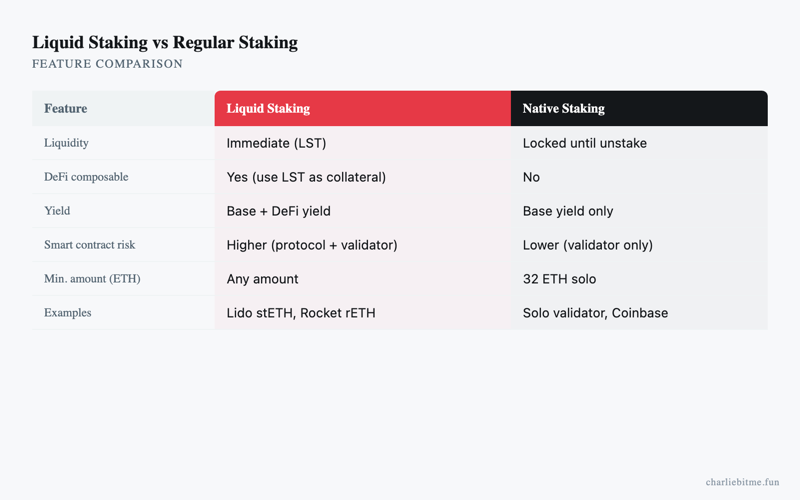
The three largest Ethereum liquid staking protocols are Lido (stETH), Rocket Pool (rETH), and Coinbase (cbETH). Lido alone holds over 28% of all staked ETH, according to data from Dune Analytics. The LSTs these protocols issue trade on decentralized exchanges and are accepted as collateral across major DeFi platforms including Aave, Compound, and MakerDAO.
The mechanism creates a compounding opportunity. You earn base staking rewards through the LST (3-4% APR on Ethereum). You then deposit that LST into a lending protocol to earn additional interest, or provide it as liquidity on a DEX to earn trading fees. This layering is called “DeFi composability.” For a broader overview of staking fundamentals, see our crypto staking guide for beginners.
| Feature | Regular Staking | Liquid Staking |
|---|---|---|
| Minimum deposit (ETH) | 32 ETH (~$100K+) | Any amount (no minimum) |
| Liquidity | Locked until unstake | Tradable LST at any time |
| Unstaking period | Hours to weeks | Instant (sell LST on DEX) |
| DeFi composability | None | Full — use LST as collateral |
| Validator selection | You choose your validator | Protocol selects validators |
| Smart contract risk | Minimal (native protocol) | Additional contract risk |
| Fee | None (direct rewards) | 5-15% of staking rewards |
| Base APR (ETH, approximate) | 3-4% | 3-3.5% after fee |
Which Liquid Staking Protocols Are the Largest?
Lido Finance dominates the Ethereum liquid staking market with its stETH token. When I last checked on DefiLlama, Lido held over $30 billion in total value locked (TVL), making it the largest DeFi protocol by that metric. stETH is a rebasing token — its balance in your wallet increases daily to reflect accrued staking rewards.
Rocket Pool takes a different approach with rETH, a value-accruing token. Instead of your balance increasing, the price of rETH rises relative to ETH over time. Rocket Pool requires its node operators to post RPL collateral, adding a decentralization layer that Lido lacks. Rocket Pool’s TVL is significantly smaller — roughly $4-5 billion — but its architecture distributes validator control more broadly.
On Solana, Marinade Finance (mSOL) and Jito (JitoSOL) are the leading liquid staking protocols. JitoSOL adds MEV (maximal extractable value) rewards on top of base staking yield, which has historically boosted its APR by 0.5-1% above competitors, according to data from Jito’s public dashboard.
What Are the Risks of Liquid Staking?
Liquid staking introduces risks that native staking does not carry. Smart contract risk is the most significant. Lido’s contracts hold billions of dollars worth of ETH. A critical vulnerability in the staking contract, withdrawal mechanism, or oracle system could result in loss of funds. Lido has undergone multiple audits by firms including Quantstamp, Sigma Prime, and MixBytes, but audits reduce risk without eliminating it.
The LST peg to the underlying asset is not guaranteed. stETH trades on secondary markets and its price is set by supply and demand, not a hard redemption mechanism (though withdrawals now exist). During the June 2022 market stress, stETH temporarily depegged to 0.93 ETH on Curve, causing cascading liquidations for users who had borrowed against stETH collateral.
Centralization risk is real. Lido controls nearly a third of all staked ETH. If Lido’s governance were compromised or its validator set acted maliciously, the consequences would affect the entire Ethereum network. Ethereum core developers have publicly expressed concern about this concentration, as documented in Ethereum Foundation blog posts.
For practical guidance on securing your staking setup, see our Ethereum staking guide post-Pectra and our broader wallet security best practices.
Is Liquid Staking Worth the Extra Risk?
For most users with less than 32 ETH, liquid staking is the only practical way to earn staking rewards on Ethereum. The choice is not between liquid staking and native staking — it is between liquid staking and not staking at all. In that context, the additional yield and composability clearly justify the incremental smart contract risk.
For users who can meet the 32 ETH threshold, the decision depends on whether DeFi composability matters to you. If you plan to hold ETH long-term and have no interest in leverage or yield farming, native staking through your own validator eliminates smart contract risk entirely. If you want to use your staked capital productively across DeFi, liquid staking is the better option.
My recommendation: if you choose liquid staking, diversify across at least two protocols. Hold some stETH and some rETH. This reduces exposure to any single protocol’s smart contract risk. Also, compare the LST options for your specific chain by checking impermanent loss dynamics before committing capital to LST liquidity pools.
This article is for informational purposes only and does not constitute financial advice. Cryptocurrency investments carry substantial risk, including the risk of total loss when interacting with DeFi protocols. Always conduct your own research.
Frequently Asked Questions
- Can I lose money with liquid staking?
- Yes. Smart contract exploits, LST depegs, and validator slashing events can all result in losses. While major protocols like Lido and Rocket Pool have strong track records, no DeFi protocol is risk-free.
- Do liquid staking tokens earn rewards automatically?
- Yes. Rebasing tokens like stETH increase your wallet balance daily. Value-accruing tokens like rETH appreciate in price relative to ETH. You do not need to claim rewards manually in either case.
- Is liquid staking taxable?
- In the United States, the IRS treats staking rewards as ordinary income when received. Liquid staking complicates this because the “receipt” of rewards is continuous (rebasing) or embedded in price appreciation. Consult a tax professional for your specific situation.
- What is the minimum amount to liquid stake ETH?
- Most liquid staking protocols have no minimum. Lido accepts any amount of ETH. Rocket Pool accepts any amount of ETH for staking (running a node requires 8 ETH minimum). This accessibility is a major advantage over native staking’s 32 ETH requirement.
Sources
- DefiLlama — Lido Finance TVL — checked when I last reviewed this article
- Rated Network — Ethereum Staking APR Data
- Dune Analytics — Lido Staking Dashboard
- Jito — Solana MEV-enhanced Staking
- Rocket Pool — Decentralized Ethereum Staking