Yield farming is the practice of depositing cryptocurrency into DeFi protocols to earn returns through trading fees, token rewards, or interest. It was wildly profitable during 2020-2021, with annual yields regularly exceeding 100%. Those days are over. Current yields on established protocols range from 2% to 15% APY for most strategies, and risk-adjusted returns are significantly lower. Yield farming is still profitable for disciplined investors who understand impermanent loss, smart contract risk, and the difference between real yield and inflationary emissions.
In This Article
How Does Yield Farming Actually Work?
Yield farming involves providing capital to a DeFi protocol in exchange for a share of its revenue or governance token rewards. The most common mechanism is liquidity provision: you deposit a pair of tokens into an automated market maker (AMM) pool, traders swap against your liquidity, and you earn a percentage of every trade.
On Uniswap V3, liquidity providers earn 0.05% to 1% of each swap depending on the fee tier selected. On Curve Finance, stablecoin pools typically earn 0.04% per swap plus CRV token incentives. Aave and Compound pay interest on deposited assets funded by borrowers on the other side.
The yield comes from three sources. Trading fees are real yield — someone pays you for the service of providing liquidity. Token emissions are inflationary rewards — the protocol prints its governance token and gives it to you, diluting existing holders. Interest from lending is real yield paid by borrowers. The distinction matters because real yield is sustainable while emissions-based yield is not.
What Are Current Yield Farming Returns Compared to Historical?
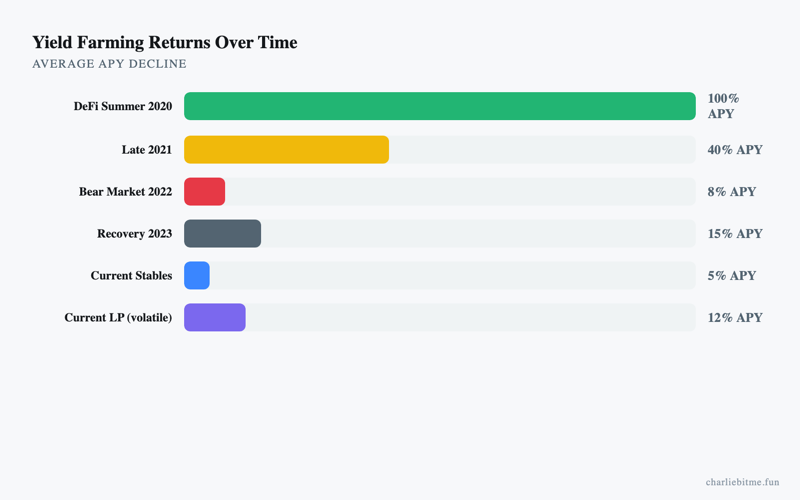
Returns have compressed dramatically from the DeFi Summer peak. Protocols that once offered 500%+ APY now return single digits on comparable strategies. This is a sign of market maturity, not failure.
| Strategy | Protocol | 2021 Peak APY | Current APY | Yield Type |
|---|---|---|---|---|
| ETH/USDC liquidity | Uniswap V3 | 40-80% | 5-15% | Trading fees (real) |
| Stablecoin lending | Aave V3 | 10-25% | 3-8% | Interest (real) |
| Stablecoin LP | Curve Finance | 20-50% | 2-6% | Fees + CRV emissions |
| Liquid staking + DeFi | Lido + Aave | N/A | 4-7% | Staking + interest (real) |
| Concentrated liquidity | Uniswap V3 / Maverick | 100-300% | 10-30% | Trading fees (real, active mgmt) |
The data from DefiLlama Yields shows a clear trend: pools with TVL above $10 million rarely sustain yields above 15% APY. Higher advertised rates almost always come from inflationary token emissions that decrease over time. The sustainable floor for established protocols sits around 3-8% for passive strategies.
What Is Real Yield Versus Inflationary Yield?
This distinction separates profitable farming from value destruction. Real yield comes from actual economic activity — trading fees paid by users, interest paid by borrowers, or revenue generated by the protocol. Inflationary yield comes from newly minted tokens allocated to liquidity providers as incentives.
A protocol paying 50% APY entirely in its own governance token is printing money. If the token price drops 50%, your actual return is zero. If it drops 80% — which governance tokens routinely do after initial hype — you have lost money despite “earning yield.” The farming community calls this getting “farmed” instead of farming.
Real yield protocols include Uniswap (100% of yield from trading fees), GMX (yield from leveraged trading fees distributed in ETH/AVAX), and Aave (yield from borrower interest). These generate revenue whether token prices rise or fall. For more on how these returns compare to simpler strategies, see our crypto staking guide.
What Is the Biggest Risk in Yield Farming?
Impermanent loss is the single biggest risk for liquidity providers. It occurs when the price ratio between your two deposited tokens changes. The larger the divergence from your entry ratio, the more value you lose compared to simply holding the tokens.
If you deposit equal values of ETH and USDC into a pool and ETH doubles in price, your pool position is worth less than if you had just held the tokens separately. The math guarantees this outcome for any price change in either direction. Trading fees must exceed impermanent loss for the position to be net profitable. In our detailed guide on impermanent loss, we walk through the exact formulas and break-even calculations.
Smart contract risk is the second major threat. DeFi protocols are code, and code has bugs. Exploits have drained billions from farming protocols. According to Rekt News, DeFi hacks and exploits exceeded $3 billion in losses cumulatively. No amount of yield compensates for a total loss of principal.
My honest take: yield farming is only worth the effort if you stick to top-tier protocols with audited contracts, focus on real yield pools, and actively manage positions. Passive farming into random high-APY pools is a reliable way to lose money.
What Strategies Work for Different Capital Sizes?
Under $5,000: Gas costs on Ethereum mainnet erode small positions. Farm on Layer 2 networks (Arbitrum, Base, Optimism) or alternative L1s (Solana) where transaction fees are under $0.01. Focus on stablecoin lending on Aave V3 for minimal risk, or concentrated liquidity on Uniswap V3 with tight ranges for higher returns.
$5,000-$50,000: Diversify across 3-4 strategies. Allocate 40% to stablecoin yield (Aave, Curve), 30% to liquid staking derivatives (stETH in DeFi), and 30% to active concentrated liquidity positions. Rebalance monthly.
Above $50,000: Consider yield aggregators like Yearn Finance that automate compounding and strategy rotation. Larger positions also make Ethereum mainnet economically viable. At this scale, the yield optimizer’s management fee (typically 2% of yield, 20% of performance) is worth the automation.
Regardless of size, never allocate more than 20% of your crypto portfolio to any single farming position. Diversification across protocols and chains limits exposure to any single smart contract exploit. See our guide on wrapped tokens for how assets move between chains for farming. Read our research methodology for how we evaluate DeFi protocols.
Frequently Asked Questions
- Is yield farming taxable?
- Yes. In the United States, yield farming rewards are taxable as ordinary income when received, based on fair market value at the time of receipt. Subsequent sale of reward tokens is a separate capital gains event. The IRS treats liquidity provision similarly to other DeFi income.
- Can I lose all my money yield farming?
- Yes. Smart contract exploits can drain 100% of deposited funds. Rug pulls by anonymous protocol teams happen regularly. Even on legitimate protocols, extreme impermanent loss combined with a token price crash can reduce your position to near zero.
- What is the minimum amount needed to start yield farming?
- On Layer 2 networks or Solana, you can start with as little as $50-$100. On Ethereum mainnet, gas costs make positions under $5,000 impractical. The minimum is set by transaction costs, not protocol requirements.
- Is yield farming better than staking?
- Staking is simpler and carries lower risk — you lock tokens in a proof-of-stake network and earn validator rewards. Yield farming offers potentially higher returns but with impermanent loss, smart contract risk, and active management requirements. For most people, staking is the better choice.
Sources
- DefiLlama Yields — defillama.com (checked when I last reviewed)
- Rekt News — DeFi Exploit Database — rekt.news
- Uniswap V3 Documentation — docs.uniswap.org
- Aave V3 Documentation — docs.aave.com
This article is for informational purposes only and does not constitute investment advice. DeFi protocols carry smart contract risk and potential total loss of funds. Never invest more than you can afford to lose.