Crypto staking generates passive income by locking tokens to help validate transactions on proof-of-stake blockchains. Yields range from roughly 3-5% on Ethereum to over 15% on smaller networks, but the income is not risk-free — validator slashing, token price declines, and lock-up periods can erode or eliminate returns. The best staking strategy balances yield against these risks while accounting for the tax obligations that staking income creates.
In This Article
- How Does Staking Generate Passive Income?
- What Are the Current Staking Yields by Blockchain?
- What Is the Difference Between Solo Staking, Pooled Staking, and Liquid Staking?
- How Can You Compound Staking Returns?
- What Are the Tax Implications of Staking Income?
- What Are the Realistic Risks of Staking for Passive Income?
- Frequently Asked Questions
How Does Staking Generate Passive Income?
Proof-of-stake blockchains reward validators for securing the network. When you stake tokens, you contribute to the validator pool that processes and verifies transactions. In return, the network pays you a portion of newly minted tokens and transaction fees. This is the fundamental mechanism behind staking income.
The process is analogous to earning interest, but the source is different. Bank interest comes from lending your deposit to borrowers. Staking rewards come from the blockchain protocol itself — you are paid for providing economic security, not for lending capital. According to the Ethereum Foundation documentation, Ethereum staking rewards come from new ETH issuance and priority fees from transactions.
For a comprehensive introduction to how staking works across different blockchains, read our crypto staking guide for beginners.
What Are the Current Staking Yields by Blockchain?
Staking yields vary significantly by network and change as the total staked amount fluctuates. More stakers means rewards are split among more participants, pushing yields down.
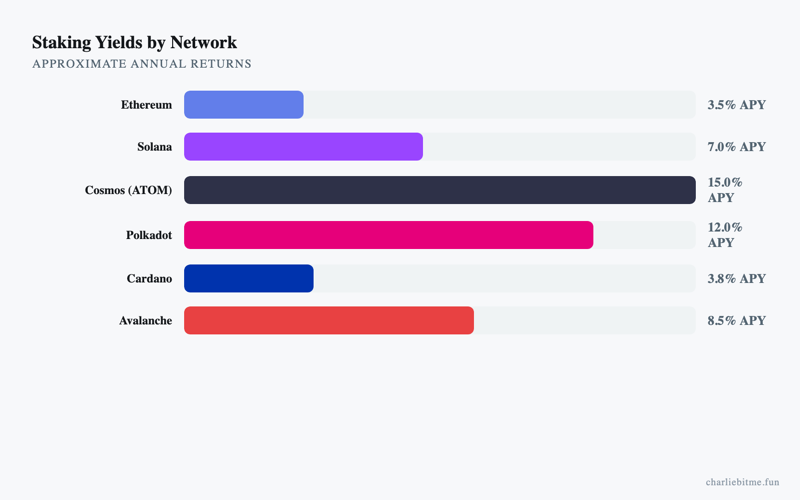
| Blockchain | Token | Approximate APR | Lock-up Period | Minimum Stake |
|---|---|---|---|---|
| Ethereum | ETH | 3-4% | Withdrawal queue (days to weeks) | 32 ETH (solo) / no min (pooled) |
| Solana | SOL | 6-8% | ~2-3 day cooldown | No minimum |
| Cardano | ADA | 3-5% | None (liquid delegation) | No minimum |
| Polkadot | DOT | 10-14% | 28-day unbonding | Varies by era |
| Cosmos | ATOM | 15-20% | 21-day unbonding | No minimum |
| Avalanche | AVAX | 8-10% | 14-day unbonding | 25 AVAX (delegation) |
| Sui | SUI | 3-4% | ~1 epoch cooldown | No minimum |
These figures reflect approximate rates when I last checked. Actual yields change daily based on network participation, validator performance, and protocol updates. StakingRewards.com provides real-time yield data across networks. Higher yields generally correlate with higher risk — Cosmos’s 15-20% APR comes with a 21-day unbonding period during which your tokens are illiquid and exposed to price swings.
What Is the Difference Between Solo Staking, Pooled Staking, and Liquid Staking?
Solo staking means running your own validator node. On Ethereum, this requires 32 ETH (worth over $100,000 at current prices), technical knowledge to maintain hardware and software, and near-perfect uptime. You keep 100% of rewards minus network penalties. Solo staking is the most decentralized option and provides the highest raw yield since no intermediary takes a cut.
Pooled staking lets you stake any amount by delegating to a validator operated by someone else. Staking pools like Rocket Pool, Lido, and exchange staking services (Coinbase, Kraken) handle the infrastructure. You earn rewards minus a commission — typically 5-15% of staking rewards. According to Rated.Network data, the average commission across major staking pools is around 10%.
Liquid staking gives you a tradeable token representing your staked position. Deposit ETH into Lido, receive stETH. The stETH earns staking rewards (reflected in its exchange rate) while remaining freely transferable. You can use stETH in DeFi protocols for additional yield. The trade-off is smart contract risk from the liquid staking protocol itself. Read our guide on impermanent loss in DeFi if you plan to use liquid staking tokens in liquidity pools.
My recommendation: pooled staking through a reputable non-custodial protocol like Rocket Pool offers the best balance of yield, accessibility, and decentralization for most people. Exchange staking is simpler but concentrates network power in fewer validators.
How Can You Compound Staking Returns?
Compounding means reinvesting your staking rewards back into the staking position. On most networks, this must be done manually — claim rewards, then stake the claimed tokens. Some protocols automate this process.
On Ethereum, staking rewards accumulate on the beacon chain and must be claimed periodically. For solo validators, rewards accrue to the withdrawal address automatically after the Shapella upgrade. For liquid staking, compounding happens automatically — Lido’s stETH is a rebasing token that increases in balance daily.
On Cosmos-based chains, you must manually claim and restake rewards. Staking dashboards like Keplr wallet show your pending rewards and allow one-click restaking. The difference between claiming and restaking monthly versus letting rewards sit unclaimed compounds significantly over a year.
A practical example: staking $10,000 in SOL at 7% APR without compounding yields $700 after one year. With monthly compounding (restaking rewards twelve times), the yield is approximately $723. The difference grows with higher yields and longer time horizons. At 15% APR with monthly compounding, $10,000 becomes $11,607 — an extra $107 compared to simple interest. See our guide on yield farming for more aggressive yield strategies.
What Are the Tax Implications of Staking Income?
In the United States, staking rewards are taxable as ordinary income when you receive them, according to IRS Revenue Ruling 2023-14. The taxable amount is the fair market value of the tokens at the time of receipt. This creates an ongoing tax obligation that reduces your effective yield.
If you stake ETH and earn 0.01 ETH in rewards when ETH is priced at $3,500, you owe income tax on $35. If ETH later drops to $2,000 and you sell that 0.01 ETH for $20, you also have a capital loss of $15 that can offset other gains.
Track every reward receipt with the date, amount, and fair market value. Staking through an exchange simplifies record-keeping since the exchange may issue a 1099-MISC. Self-custodied staking requires manual tracking via blockchain explorer data or portfolio tools like CoinTracker or Koinly. Read our research methodology for how we verify tax guidance against IRS publications.
What Are the Realistic Risks of Staking for Passive Income?
Staking is not a savings account. Three material risks can reduce or eliminate your returns.
Price risk is the largest. A 7% APR on a token that drops 50% in value means a net loss. Staking rewards are denominated in the staked token, not in dollars. Your income only has value if the token retains its purchasing power.
Slashing risk means losing a portion of your staked tokens as a penalty for validator misbehavior (double-signing, extended downtime). For solo stakers, this is your own operational risk. For delegated staking, you bear the risk of your chosen validator’s performance. According to beaconcha.in data, Ethereum slashing events are rare but have occurred — typically from misconfigured validators running duplicate instances.
Lock-up risk prevents you from selling during market downturns. Polkadot’s 28-day unbonding and Cosmos’s 21-day period mean your tokens are trapped during exactly the conditions when you might want to exit. Liquid staking mitigates this, but liquid staking tokens can trade at a discount to the underlying asset during market stress.
Frequently Asked Questions
- How much money do you need to start earning passive income from staking?
- Most networks and staking services have no minimum or very low minimums. You can stake as little as 0.01 SOL on Solana or a fraction of an ETH through Lido or Rocket Pool. Solo Ethereum validation requires 32 ETH, but pooled staking has no practical minimum. Exchange staking on Coinbase or Kraken often starts at the price of one token.
- Is staking safer than yield farming for passive income?
- Generally, yes. Staking involves one smart contract layer (the staking protocol or native chain mechanism) while yield farming typically involves multiple protocol interactions, each adding smart contract risk. Staking yields are lower but more predictable. Yield farming can offer higher returns but introduces impermanent loss, composability risk, and higher complexity.
- Can you live off crypto staking income?
- Theoretically, but it requires substantial capital. At 5% APR, generating $50,000 annually requires $1 million in staked assets. That capital is fully exposed to crypto price volatility. A 30% market decline wipes out six years of staking income. Most people treat staking as supplementary income rather than a primary income source.
- Do staking rewards compound automatically?
- It depends on the network and method. Liquid staking tokens like stETH compound automatically through rebasing. Cosmos-based chains require manual claim-and-restake. Exchange staking varies — Coinbase auto-compounds for some assets. Check your specific staking provider’s documentation.
This article is for informational purposes only and does not constitute financial or investment advice. Cryptocurrency staking involves risk including loss of staked capital. Yields are not guaranteed. Consult a qualified financial advisor before making investment decisions.
Sources
- Ethereum Foundation — Staking on Ethereum — Official staking documentation (checked August 2026)
- StakingRewards.com — Real-time staking yield data across networks (checked August 2026)
- Rated.Network — Validator performance and staking pool analytics (checked August 2026)
- IRS Revenue Ruling 2023-14 — Tax treatment of staking rewards (checked August 2026)
- Beaconcha.in — Ethereum beacon chain explorer and slashing data (checked August 2026)