A cryptocurrency whitepaper is the foundational document explaining a project’s technology, tokenomics, and vision. Evaluating one requires reading past the marketing language to assess whether the technical claims are feasible, the token economics are sustainable, and the team is credible. Most whitepapers promise revolutionary technology — fewer than 10% of crypto projects from any given year are still active five years later, so learning to spot red flags early is the single most valuable research skill.
In This Article
What Should a Legitimate Crypto Whitepaper Contain?
A credible whitepaper addresses five core sections: the problem statement, the technical solution, the token economics, the team and governance structure, and the roadmap. Missing or vague sections are a warning sign.
The problem statement should identify a specific, real problem that existing solutions handle poorly. Bitcoin’s whitepaper by Satoshi Nakamoto defined the double-spend problem in electronic cash with mathematical precision. Ethereum’s whitepaper by Vitalik Buterin identified the limitation of Bitcoin’s scripting language and proposed a Turing-complete alternative. Compare this to whitepapers that describe problems in generic terms — “the current system is broken” — without quantifying the inefficiency.
The technical section should explain the consensus mechanism, data structures, cryptographic primitives, and protocol architecture in enough detail for a developer to evaluate feasibility. According to Messari’s crypto research standards, a whitepaper that hand-waves the technical implementation while emphasizing partnerships and ecosystem growth is a marketing document, not a technical specification.
For a broader framework on evaluating any crypto project, see our pillar guide on how to research a cryptocurrency before buying.
How Do You Evaluate the Tokenomics Section?
Tokenomics determines whether a project’s economic model is sustainable. The three critical elements are supply mechanics, distribution, and utility.
| Tokenomics Factor | Green Flag | Red Flag |
|---|---|---|
| Total supply | Fixed or deflationary with clear schedule | Unlimited minting with no burn mechanism |
| Team allocation | 10-20% with 2-4 year vesting and cliff | Over 30% unlocked at launch |
| Vesting schedule | Linear vesting with 6-12 month cliff | No vesting or short cliff with large unlocks |
| Token utility | Required for protocol function (gas, governance, staking) | Utility limited to “holding for price appreciation” |
| Initial distribution | Fair launch or broad distribution (community, airdrop) | Over 50% to insiders (team + early investors) |
| Inflation rate | Under 10% annually with decreasing schedule | High inflation funding unsustainable yields |
Check the vesting schedule with particular care. A project where 40% of tokens unlock in the first year after launch creates massive sell pressure. According to Token Unlocks data, large vesting events (called “cliff unlocks”) correlate with 10-30% price drops in the weeks surrounding the unlock date. Understanding fully diluted valuation helps you assess whether the current price accounts for future token supply.
The token must serve a real function within the protocol. Governance rights alone are weak utility — most token holders never vote. Staking rewards are stronger but only if the yield comes from protocol revenue rather than inflationary emissions. The strongest utility is when the token is required to use the protocol (like ETH for gas on Ethereum).
How Do You Verify the Team Behind a Crypto Project?
Team verification is where most scam projects fall apart under scrutiny. The whitepaper should list core team members with verifiable identities and relevant professional history.
Cross-reference team claims against LinkedIn profiles, GitHub contribution histories, and conference appearances. A CTO claiming ten years of distributed systems experience should have a visible professional trail. According to Chainalysis’s annual crime report, anonymous-team projects account for a disproportionate share of rug pulls and exit scams.
Check GitHub activity for the project’s repositories. A legitimate technical team produces consistent code commits over months. Repositories that consist of forked code with minimal original contributions suggest the team lacks the technical depth claimed in the whitepaper. GitHub’s contribution graph makes this trivially verifiable.
Advisors listed in the whitepaper should have publicly acknowledged their involvement. Fake advisor listings are common — projects list prominent names without their knowledge or consent. A quick check of the advisor’s Twitter or LinkedIn for any mention of the project confirms or disproves the claim. Whether a project claims to offer airdrops or revolutionary technology, team verification follows the same process.
What Are the Biggest Red Flags in a Crypto Whitepaper?
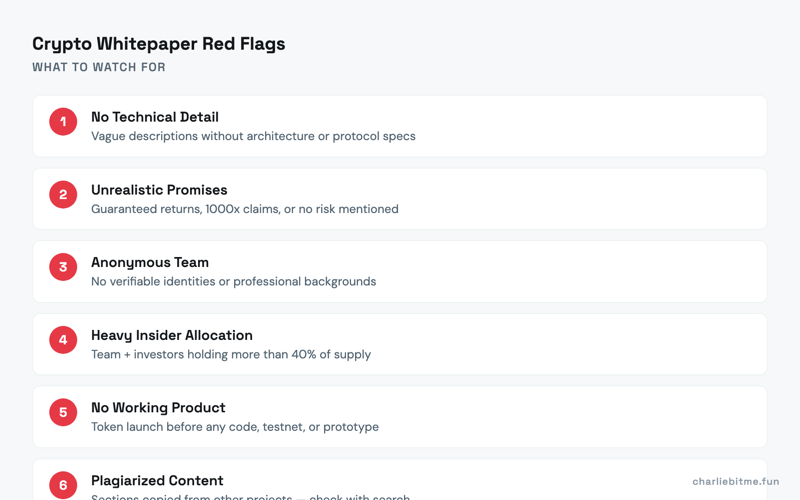
Red flags fall into three categories: technical impossibilities, economic unsustainability, and credibility gaps.
Technical red flags:
- Claims of “solving” the blockchain trilemma (decentralization, security, scalability) without trade-offs
- Proprietary consensus mechanisms described only in marketing terms, not formal specifications
- No testnet, no code repository, and no audit — just a whitepaper and a token sale
- Copy-pasted sections from other whitepapers (use a plagiarism checker)
Economic red flags:
- Promising fixed returns (e.g., “20% guaranteed APY”) — this is economically impossible without external subsidies
- Circular tokenomics where the only demand driver is speculation on price appreciation
- Multi-level referral structures embedded in the token distribution
Credibility red flags:
- Anonymous team on a project handling user funds
- No smart contract audit from a recognized firm (CertiK, OpenZeppelin, Trail of Bits, Sigma Prime)
- Urgency tactics — “limited token sale ends in 48 hours” pressure
- Whitepaper published as a PDF only with no version control or update history
My opinion: the single strongest signal of a legitimate project is an active, open-source code repository with multiple contributors and a track record of consistent development. Code does not lie the way marketing documents can. Read our research methodology for more on how we evaluate projects.
How Should You Compare Whitepapers Across Similar Projects?
When evaluating competing projects in the same category — say, three different Layer 2 scaling solutions — create a structured comparison across the same dimensions.
Compare the consensus mechanism and its trade-offs. Compare the team size, experience, and funding. Compare token distribution fairness. Compare mainnet launch status and actual usage metrics (TVL, transaction count, active addresses). On-chain data from Dune Analytics or Artemis provides verifiable usage numbers that no whitepaper can fabricate.
According to Ethereum co-founder Vitalik Buterin’s writings on L2 evaluation, the most important technical metric for a rollup is the degree of decentralization in its sequencer and prover. A whitepaper that describes a decentralized sequencer design but currently runs a single centralized sequencer should be evaluated on its current state, not its roadmap promises.
The best whitepapers acknowledge their own limitations. Bitcoin’s whitepaper noted that its security model assumed honest nodes controlled a majority of computing power. Ethereum’s whitepaper discussed the gas cost trade-offs of Turing completeness. Transparency about trade-offs signals intellectual honesty.
Frequently Asked Questions
- How long should a crypto whitepaper be?
- Length varies widely and is not a quality signal. Bitcoin’s whitepaper is 9 pages. Ethereum’s is roughly 36 pages. Some DeFi protocol whitepapers exceed 60 pages. What matters is whether the document covers the five core sections — problem, solution, tokenomics, team, roadmap — with sufficient technical depth. A short, precise whitepaper is better than a long, vague one.
- Should I invest in a project that only has a litepaper?
- A litepaper is a condensed, non-technical summary aimed at general audiences. It is acceptable as a companion to a full whitepaper or technical specification, but not as a replacement. If a project raising capital has only a litepaper and no technical documentation, that is a significant red flag. The technical claims should be documented in enough detail for independent verification.
- Are audited whitepapers safer?
- Smart contract audits and whitepaper reviews are different. An audit by CertiK, Trail of Bits, or OpenZeppelin examines the deployed code for vulnerabilities — not the whitepaper’s claims. A clean audit means the code works as intended; it does not validate the economic model or the project’s viability. Both matter, but audits only cover code correctness.
- Where can I find whitepapers for major crypto projects?
- Most projects host their whitepaper on their official website under a “Docs” or “Resources” section. Aggregators like Messari, CoinMarketCap, and CoinGecko link to whitepapers on each project’s profile page. For older projects, the Wayback Machine (web.archive.org) preserves original whitepaper versions before later edits.
This article is for informational purposes only and does not constitute financial or investment advice. Cryptocurrency investments carry significant risk including total loss of capital. Always conduct your own research and consult a qualified financial advisor before investing.
Sources
- Bitcoin Whitepaper — Satoshi Nakamoto — Original Bitcoin protocol specification (checked August 2026)
- Ethereum Whitepaper — Vitalik Buterin — Ethereum protocol specification (checked August 2026)
- Messari — Crypto research standards and project profiles (checked August 2026)
- Token Unlocks — Vesting schedule tracker for crypto projects (checked August 2026)
- Chainalysis — Crypto Crime Report — Annual data on scams and rug pulls (checked August 2026)