Finding new cryptocurrencies before they list on major exchanges requires monitoring launchpads, testnets, airdrop aggregators, and social channels where early projects announce themselves. The highest returns in crypto come from early access, but so do the highest risks — most new tokens fail. This guide covers where to look, how to evaluate what you find, and the red flags that separate legitimate launches from scams.
In This Article
Early discovery is only useful if you can evaluate what you find. Before investing in any new token, run it through the full cryptocurrency research framework we outline in our pillar guide. The process below gets you to the discovery stage. The research framework keeps you from losing money there.
Where Do New Crypto Projects Launch Before Exchange Listings?
The four main discovery channels are launchpad platforms (Binance Launchpad, CoinList), testnet campaigns, social media communities (Crypto Twitter, Discord), and on-chain activity monitors. Each channel has different risk profiles and requires different skills to navigate.
| Discovery Channel | How It Works | Typical Timeline Before Listing | Risk Level | Skill Required |
|---|---|---|---|---|
| Launchpads (Binance, CoinList) | Curated token sales with vetting | 1-3 months | Medium | Low — just apply |
| Testnet participation | Use protocol before mainnet, earn potential airdrop | 3-12 months | Low (time cost, not capital) | Medium — technical interaction |
| Social / community | Follow developers and VCs on X/Discord | 1-6 months | High — unvetted information | Low — but filtering skill needed |
| On-chain monitoring | Track VC wallet movements and new contract deployments | Weeks to months | Medium | High — requires chain analysis |
Launchpad platforms like Binance Launchpad and CoinList provide the most curated experience. These platforms conduct due diligence before listing a project. However, access is often restricted by lottery, staking requirements, or geographic limitations.
How Do Testnet Campaigns Lead to Airdrops?
Many protocols reward early testnet users with token airdrops when they launch on mainnet. Arbitrum’s airdrop distributed over $1 billion worth of ARB tokens to early users. Optimism, Jito, and Jupiter followed similar patterns. Participating in testnets costs nothing except time and gas fees on the test network.
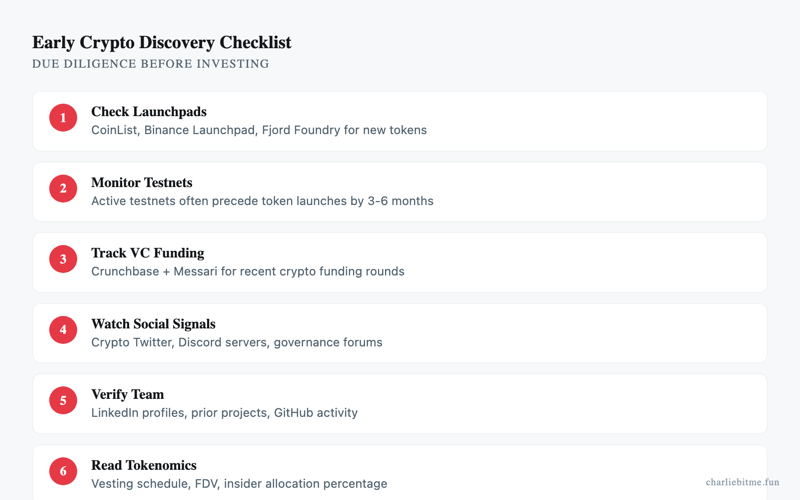
The strategy is straightforward: identify protocols that have raised venture capital but have not launched a token yet. Use their testnet version. Interact with the core features — swaps, bridges, lending, staking. Document your activity. Wait for the token launch announcement.
According to DefiLlama’s protocol tracker, funded protocols without tokens are easy to identify. Filter by total value locked and check whether a governance token exists. If it does not, and the protocol has significant venture backing, an airdrop is likely.
What On-Chain Signals Reveal Early Projects?
Tracking venture capital wallet movements, new smart contract deployments, and rising TVL in unlisted protocols reveals projects before they hit mainstream radar. Tools like Nansen label known VC wallets, letting you see where professional money is flowing.
When a wallet labeled as Andreessen Horowitz or Paradigm deploys capital to a new contract, that is a signal worth investigating. The protocol may be months from a public launch, but the venture commitment means it has passed at least some level of due diligence.
Dune Analytics dashboards track new contract deployments across Ethereum, Solana, and other chains. A sudden spike in unique wallet interactions with a new contract — especially without any marketing — often precedes a formal announcement. Understanding fully diluted valuation helps you assess whether an early-stage token is reasonably priced.
What Are the Red Flags of Fraudulent New Tokens?
Anonymous teams, locked liquidity promises that are not actually locked, no GitHub activity, copied whitepapers, and artificial social media followings are the five most common red flags. The majority of new tokens launched each day are scams or will fail within months. Skepticism is your most valuable tool.
Check the smart contract on a blockchain explorer. If the deployer wallet also deployed dozens of other failed tokens, walk away. If the token contract has a mint function accessible to the owner, they can create unlimited tokens and dump them. Tools like CoinGecko and Token Sniffer analyze contracts for known scam patterns.
Never invest based solely on social media hype. A project with 100,000 Twitter followers but no working code, no audited contract, and no identifiable team is almost certainly a scam or a meme with no lasting value. Use the on-chain analysis techniques we cover to verify real usage.
My opinion: the single most reliable filter is checking whether the protocol has real users generating real transactions before any token incentive exists. If the only reason people use a protocol is to farm a potential airdrop, the usage will collapse after the token launches.
How Do Token Unlock Schedules Affect New Listings?
Token unlock schedules determine when insiders — team members, VCs, and early investors — can sell their holdings, creating predictable selling pressure at known dates. Many new tokens see sharp price declines within the first 6-12 months as locked tokens begin vesting.
According to Token Unlocks, major vesting events often coincide with price drops of 10-30% in the weeks surrounding the unlock date. Before investing in any newly listed token, check the vesting schedule. A token where 20% of supply unlocks next month has fundamentally different risk than one where the next major unlock is a year away.
Read more about our verification standards in our research methodology.
Frequently Asked Questions
- How much money do I need to invest in new crypto projects?
- Testnet participation and airdrop farming require only time and minimal gas fees. Launchpad allocations can be as low as $100-$500. Never invest more than you can afford to lose entirely, as most new tokens fail.
- Are crypto launchpads safe?
- Major launchpads like Binance Launchpad and CoinList vet projects, but vetting does not guarantee returns. Smaller, unknown launchpads carry significantly higher scam risk. Stick to platforms with established track records.
- How do I know if a testnet airdrop is coming?
- No protocol guarantees airdrops. The strongest signals are: venture funding without a token, a governance discussion mentioning token distribution, and the protocol publicly encouraging testnet usage. Community research sites like DeFi Llama and airdrop aggregators track likely candidates.
Sources
- Binance Launchpad — accessed when I last checked
- DefiLlama Protocol Tracker — accessed when I last checked
- Token Unlocks — Vesting Schedule Tracker — accessed when I last checked
- Nansen Wallet Intelligence — accessed when I last checked
This article is for informational purposes only and does not constitute financial advice. New cryptocurrency projects carry extreme risk, including total loss of capital. Consult a qualified financial advisor before making investment decisions.