A crypto airdrop is a distribution of free tokens by a blockchain project to wallet addresses that meet specific criteria. Projects use airdrops to decentralize token ownership, reward early users, and bootstrap network effects. Qualifying typically requires using a protocol before it launches a token, holding specific assets, or completing on-chain tasks. The largest airdrops — Uniswap, Arbitrum, Jupiter — distributed thousands of dollars to individual wallets based on prior activity.
In This Article
What Types of Crypto Airdrops Exist?
Airdrops fall into four categories based on how recipients qualify. Understanding the type determines your farming strategy.
Retroactive airdrops reward wallets that used a protocol before any token announcement. Uniswap distributed 400 UNI (worth roughly $1,400 at launch) to every wallet that had executed at least one swap on the platform before September 2020. No advance notice was given. These are the most valuable airdrops because they reward genuine usage, not manufactured activity.
Task-based airdrops require users to complete specific actions — bridging assets to a new chain, providing liquidity, executing a certain number of transactions, or participating in testnet programs. Arbitrum’s ARB airdrop used a points system that weighted the number of transactions, volume, and time spent interacting with the network. Arbitrum’s eligibility criteria were published after the snapshot, making them retroactive as well.
Holder airdrops distribute tokens to wallets holding specific assets at a snapshot block. ApeCoin (APE) was airdropped to Bored Ape Yacht Club NFT holders. Cosmos ecosystem airdrops frequently target ATOM stakers. These reward existing community members rather than new users.
Community and governance airdrops reward participation in governance, forum discussions, or community contributions. These are less common but incentivize deeper engagement than simple usage. ENS, the Ethereum Name Service, airdropped tokens weighted partly by how long users had registered .eth domains.
How Do Protocols Decide Who Gets an Airdrop?
Protocol teams take a snapshot of blockchain state at a specific block number. This captures every wallet’s history of interactions, balances, and activity metrics. The snapshot date is almost never announced in advance — this is deliberate, to reward genuine users rather than last-minute farmers.
| Protocol | Token | Key Eligibility Criteria | Approximate Value per Wallet |
|---|---|---|---|
| Uniswap | UNI | Executed at least 1 swap before Sep 2020 | $1,400 at launch |
| Arbitrum | ARB | Transaction count, volume, time active, bridge usage | $1,500-$10,000+ |
| Jupiter | JUP | Swap volume on Jupiter aggregator (Solana) | $500-$5,000+ |
| Optimism | OP | Bridging, governance participation, repeat usage | $1,000-$5,000 |
| ENS | ENS | .eth domain registration duration | $2,000-$30,000+ |
| Apecoin | APE | BAYC/MAYC NFT holders | $80,000+ (BAYC holders) |
Common weighting factors include: number of distinct months active, total transaction count, total value transacted, number of distinct protocols used, liquidity provision duration, and governance participation. Projects increasingly use multi-factor scoring to distinguish genuine users from bots running thousands of identical transactions. For a framework on evaluating new projects and their token models, see our cryptocurrency research guide.
What Is Airdrop Farming and How Do People Do It?
Airdrop farming is the deliberate strategy of using protocols that have not yet launched tokens, with the expectation of receiving a future airdrop. The logic is simple: many of the most successful DeFi and infrastructure projects distribute tokens to early users. Using them before launch costs gas fees but can yield significant returns if an airdrop materializes.
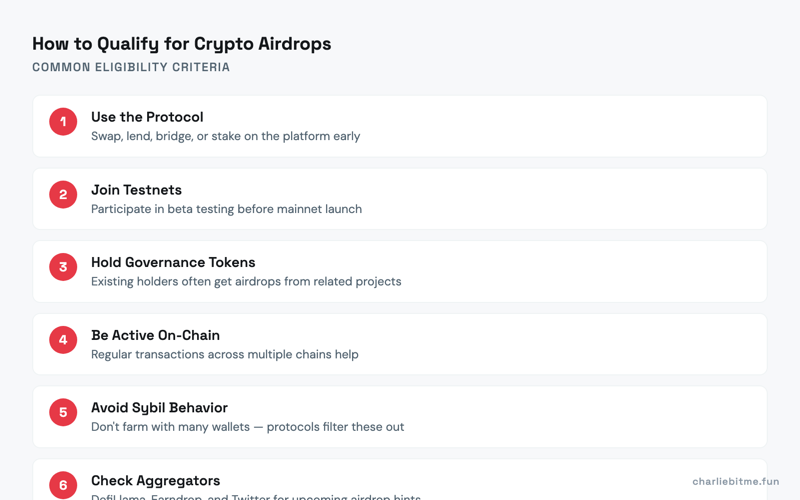
The standard farming playbook includes: bridge assets to new Layer 2 networks (zkSync, Scroll, Linea, Base), swap tokens on the network’s leading DEXs, provide liquidity in key pools, interact with lending protocols, use the network consistently across multiple months (not just one burst of activity), and maintain a minimum balance rather than draining the wallet immediately.
Cost of farming varies by network. On Ethereum L1, gas fees for a farming session (10-20 transactions) might cost $50-$200. On L2 networks, the same session costs under $5. On Solana, it costs under $1. The expected value calculation is straightforward: if a protocol has a 30% chance of airdropping tokens and the average airdrop to farmers is $2,000, the expected value is $600 — well above the cost of gas on any L2.
What Are Sybil Attacks and How Do Projects Filter Them?
Sybil attacks in the airdrop context means operating many wallets to claim multiple airdrop allocations. One person running 100 wallets with identical activity patterns attempts to receive 100x the tokens. Projects actively fight this — and they are getting better at it.
Arbitrum used on-chain analysis to identify wallet clusters: groups of wallets funded by the same source, executing identical transactions in the same order, within the same time window. Flagged wallets were excluded from the airdrop. LayerZero went further, publishing a self-reporting window where suspected Sybil operators could voluntarily identify some wallets in exchange for keeping one allocation.
The risks of Sybil farming are real. Getting caught means losing the airdrop on all wallets, not just the flagged ones. The gas costs of operating dozens of wallets add up. And projects increasingly share Sybil data with each other, meaning getting flagged by one protocol can affect eligibility across the ecosystem.
My clear advice: use one or two wallets with genuine activity. The risk-reward of Sybil farming has shifted dramatically against operators as detection tools improve. A single wallet with deep, consistent usage across multiple protocols will almost always qualify for more airdrops than a cluster of bot-operated wallets that get flagged.
Which Protocols Are Most Likely to Airdrop Next?
Projects that have raised venture capital, have active users, and have not yet launched a token are the primary candidates. The presence of VC funding creates a token incentive — venture investors need a liquid token to realize returns.
Several categories consistently produce airdrops: new Layer 2 networks (any rollup with a foundation but no token), cross-chain bridges and messaging protocols, DeFi protocols on emerging chains, wallet infrastructure projects, and social/identity platforms building on-chain.
Check project documentation and governance forums for signals. A project that sets up a foundation, creates a governance forum, or files for token-related trademarks is likely progressing toward a token launch. DefiLlama tracks protocol TVL and activity metrics that help identify which pre-token projects have real traction.
Understanding on-chain analytics is essential for finding these opportunities. See our guide on using on-chain data to analyze crypto and how to evaluate real world asset tokens as another emerging category. Read our research methodology for how we identify and verify project information.
Frequently Asked Questions
- Are crypto airdrops taxable?
- Yes, in the United States. The IRS treats airdropped tokens as ordinary income at fair market value when you gain dominion and control. This is established in Revenue Ruling 2019-24. Report airdrop income on Schedule 1 (Form 1040). Consult a tax professional for your jurisdiction.
- Can airdrop claims be scams?
- Frequently. Scammers create fake airdrop claim pages that drain your wallet when you approve a malicious transaction. Never click airdrop links from social media or DMs. Only use official protocol websites. Verify contract addresses independently before approving any transaction.
- How much does airdrop farming cost?
- Gas costs for a farming campaign on an L2 network typically total $5-$50 over several months of periodic interactions. On Ethereum mainnet, costs range from $50-$500 depending on gas conditions. On Solana, costs are under $5 total. The primary cost is time, not money.
- Do I need to hold tokens to qualify for airdrops?
- Depends on the airdrop type. Holder airdrops require specific token balances at a snapshot. Retroactive and task-based airdrops require protocol interaction regardless of token holdings. Some airdrops combine both criteria — rewarding wallets that used the protocol and held specific assets.
Sources
- Arbitrum Foundation — Airdrop Eligibility — arbitrum.foundation (checked when I last reviewed)
- IRS Revenue Ruling 2019-24 — irs.gov
- DefiLlama — Protocol Analytics — defillama.com
- Uniswap Retroactive Airdrop Blog Post — blog.uniswap.org
This article is for informational purposes only and does not constitute investment advice. Airdrop farming involves gas costs and uncertain outcomes. Never connect your wallet to unverified claim pages.