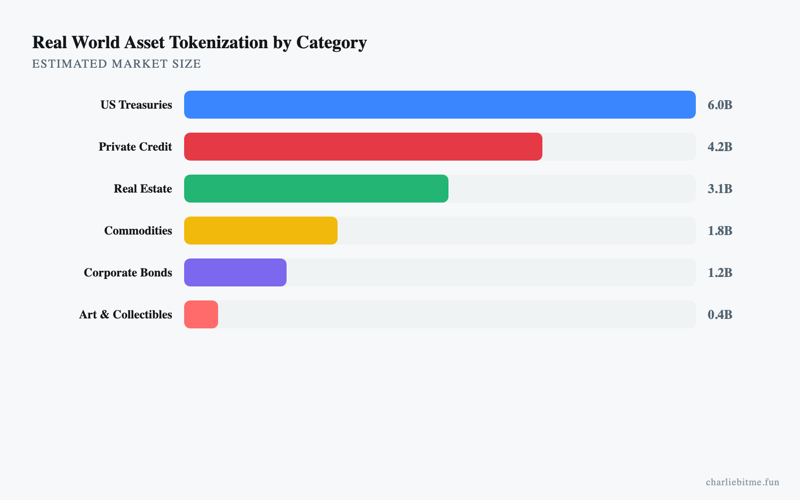
Real world asset (RWA) tokens are blockchain-based representations of physical or traditional financial assets — including U.S. Treasury bonds, real estate, commodities, and private credit. They allow investors to buy fractional ownership of assets that previously required large minimums or institutional access. The RWA sector held over $12 billion in on-chain value when I last checked, making it one of the fastest-growing segments in decentralized finance.
In This Article
What Are Real World Asset Tokens and How Do They Work?
An RWA token is a digital asset on a blockchain that represents a claim on a real-world asset held off-chain. The process is called tokenization. A legal entity holds the underlying asset — a Treasury bill, a real estate deed, a loan portfolio — and issues tokens that represent fractional ownership or yield rights to that asset.
The token holder does not physically possess the asset. They hold a cryptographic claim backed by legal agreements and, ideally, regulatory compliance. When the underlying asset generates yield (interest from a Treasury bond, rent from a property), that yield flows to token holders proportionally. The token can be traded on decentralized exchanges, providing liquidity to assets that are traditionally illiquid.
This is not a new concept dressed in blockchain. It solves a real problem: fractional access. A single U.S. Treasury bill has a minimum purchase of $100. But a tokenized private credit fund might require $100,000 minimum through traditional channels. Tokenization drops that to $100 or less on-chain.
Which Types of Assets Are Being Tokenized?
Four categories dominate the current RWA landscape. Each carries a different risk-return profile and regulatory framework.
| Asset Type | Major Protocols | Typical Yield | Risk Profile |
|---|---|---|---|
| U.S. Treasuries | Ondo Finance (OUSG), Franklin Templeton (BENJI), Backed Finance (bIB01) | 4.5-5.2% APY | Low (sovereign risk) |
| Private Credit | Centrifuge, Maple Finance, Goldfinch | 8-15% APY | Medium-High (default risk) |
| Real Estate | RealT, Lofty, Tangible | 5-10% APY | Medium (property + tenant risk) |
| Commodities | Paxos Gold (PAXG), Tether Gold (XAUT) | 0% (price appreciation only) | Medium (commodity volatility) |
Tokenized Treasuries are the breakout category. According to data from RWA.xyz, tokenized Treasury products have grown from under $100 million to over $5 billion in total value locked. This growth accelerated as DeFi yields compressed and investors sought stable, real-yield alternatives backed by the full faith of the U.S. government.
Which Protocols Lead the RWA Space?
Ondo Finance is the largest issuer of tokenized Treasuries by market cap. Its OUSG token provides exposure to short-term U.S. government bonds. The product is available to qualified purchasers and has integrated with Flux Finance for on-chain lending against the token. Ondo reports assets under management and net asset value publicly.
Centrifuge pioneered tokenized private credit on-chain. It allows businesses to borrow against real-world collateral by issuing tokens backed by invoices, trade receivables, or revenue streams. Centrifuge operates its own parachain and has integrated with MakerDAO, which allocated hundreds of millions in DAI to Centrifuge-originated credit vaults.
MakerDAO (now Sky) allocates a significant portion of its reserves to RWAs, including U.S. Treasuries and structured credit. According to Makerburn, RWA vaults generate a substantial share of the protocol’s revenue. MakerDAO is both a user and enabler of the RWA ecosystem.
Franklin Templeton, a traditional asset manager with over $1.5 trillion AUM, launched the BENJI token on Stellar and Polygon — making it the first major institutional asset manager to offer a tokenized fund directly on public blockchains. For a framework on how to evaluate any crypto asset, including RWA tokens, see our research guide.
What Are the Risks of Investing in RWA Tokens?
RWA tokens carry both crypto-native risks and traditional financial risks. This dual exposure is often underestimated.
Counterparty risk is the biggest concern. The token is only as good as the legal entity backing it. If the issuer becomes insolvent or mismanages the underlying assets, token holders may have limited recourse. Smart contracts cannot enforce off-chain legal claims.
Regulatory risk varies by jurisdiction. Many RWA tokens qualify as securities under U.S. law, which means they must comply with SEC registration requirements or operate under an exemption. Protocols that sell to non-accredited U.S. investors without proper registration face enforcement risk. The SEC has not issued comprehensive guidance on tokenized securities as of when I last checked.
Liquidity risk remains real despite tokenization’s promise. Many RWA tokens trade on thin order books. Selling a $50,000 position in a tokenized private credit product may require waiting for redemption windows rather than instant on-chain trades.
Oracle risk matters for protocols that use on-chain price feeds for RWAs. If the oracle misprices the underlying asset, it can create arbitrage opportunities that drain protocol funds or trigger incorrect liquidations.
Understanding these risks requires evaluating the specific token and issuer. For context on key valuation metrics like Bitcoin dominance and how new asset classes fit the broader market picture, and how to find new crypto projects early, explore our research library.
How Does the Regulatory Landscape Affect RWA Tokens?
Regulation is simultaneously the biggest risk and biggest catalyst for RWA adoption. Clear regulatory frameworks attract institutional capital. Ambiguous regulation keeps it on the sidelines.
The European Union’s Markets in Crypto-Assets (MiCA) regulation provides the clearest framework for tokenized securities in a major economy. MiCA establishes licensing requirements for issuers and service providers, creating a compliance path that traditional institutions can follow.
In the United States, the GENIUS Act addresses stablecoins specifically but signals Congressional appetite for digital asset regulation. The SEC has approved tokenized fund structures from Franklin Templeton and WisdomTree, suggesting a case-by-case approach rather than blanket prohibition.
Singapore’s Monetary Authority (MAS) actively promotes tokenization through Project Guardian, a collaborative industry initiative testing asset tokenization across bonds, deposits, and foreign exchange. This makes Singapore one of the most attractive jurisdictions for RWA projects. Read our research methodology for how we track regulatory developments.
Frequently Asked Questions
- Can anyone invest in RWA tokens?
- It depends on the specific token and your jurisdiction. Tokenized Treasuries from Ondo Finance and similar issuers often restrict access to qualified or accredited investors in the U.S. Commodity-backed tokens like PAXG are generally available to retail investors globally. Always check the issuer’s eligibility requirements.
- Are RWA tokens safer than other crypto investments?
- RWA tokens backed by U.S. Treasuries carry lower market risk than volatile cryptocurrencies, but they introduce counterparty and smart contract risk that Treasuries purchased directly from TreasuryDirect do not have. The risk is different, not necessarily lower overall.
- How do I verify what backs an RWA token?
- Look for published proof of reserves, third-party attestation reports, and transparent custody arrangements. Protocols like Ondo publish net asset value data. Centrifuge shows individual loan details on-chain. Avoid any RWA token that does not disclose its backing mechanism.
- What happens to my RWA token if the protocol shuts down?
- Your claim depends on the legal structure. Well-designed RWA tokens are issued by bankruptcy-remote special purpose vehicles (SPVs). If the protocol layer disappears, the SPV and its assets should remain accessible to token holders. Poorly structured tokens may leave investors with no practical recourse.
Sources
- RWA.xyz — Real World Asset Data Dashboard — rwa.xyz (checked when I last reviewed)
- Makerburn — MakerDAO Analytics — makerburn.com
- ESMA — Markets in Crypto-Assets Regulation — esma.europa.eu
- U.S. Congress — GENIUS Act — congress.gov
This article is for informational purposes only and does not constitute investment advice. RWA tokens involve regulatory, counterparty, and smart contract risks. Consult a financial advisor before investing.