A stop loss order automatically sells your cryptocurrency when the price drops to a level you set, limiting your downside on any trade. The three main types — stop-market, stop-limit, and trailing stop — each behave differently during volatile price swings. Crypto markets trade around the clock with no circuit breakers, making stop losses more important here than in traditional equities where trading halts exist.
In This Article
What Is a Stop Loss Order and How Does It Work?
A stop loss order is a conditional trade instruction that triggers when an asset reaches a specified price. You set a “stop price” below the current market price. When the market hits that price, the order activates and executes a sell. The purpose is to cap losses on a position without requiring you to monitor the market constantly.
On centralized exchanges like Coinbase, Kraken, and Binance, stop loss orders sit on the exchange’s order book until triggered. The exchange monitors the price feed and executes the order when conditions are met. The order does not hit the blockchain — it exists only on the exchange’s infrastructure until it fires.
Stop losses are particularly critical in cryptocurrency because markets never close. Bitcoin can drop 15% at 3 AM on a Sunday. Without a stop loss, you would need to be watching the market at that exact moment to sell manually. For a broader overview of trading mechanics, see the Charlie Bit Me homepage.
What Are the Different Types of Stop Loss Orders?
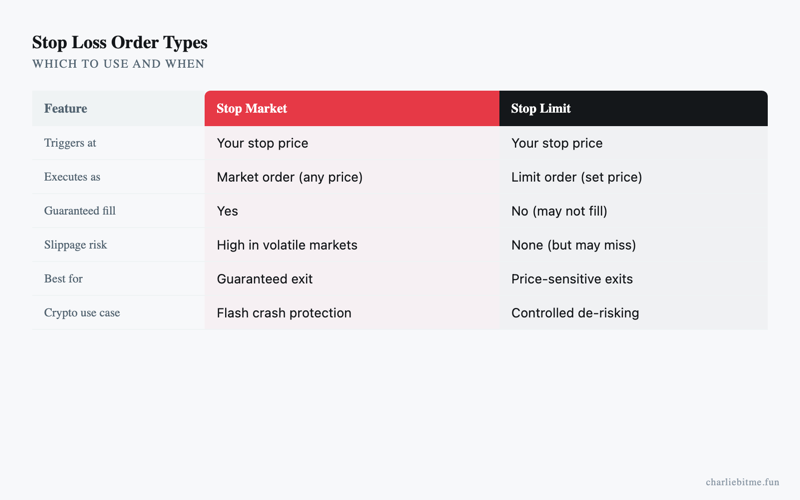
Three types of stop loss orders serve different purposes. Understanding when to use each one is the difference between a well-managed exit and an unnecessary loss.
| Type | How It Works | Best For | Risk |
|---|---|---|---|
| Stop-Market | Triggers a market order when stop price is hit | Guaranteed execution in liquid markets | Slippage during fast moves; fills at worse price than expected |
| Stop-Limit | Triggers a limit order at a specified price | Controlling exact exit price | May not fill if price gaps past the limit |
| Trailing Stop | Stop price follows market up by a fixed % or amount | Locking in profits while staying in an uptrend | Premature trigger during normal volatility |
Stop-market orders guarantee execution but not price. When Bitcoin hits your stop at $60,000, the exchange sells at the best available bid. In a flash crash, that bid might be $58,000 or lower. According to Binance’s order documentation, stop-market orders convert to market orders immediately upon trigger.
Stop-limit orders guarantee price but not execution. You set both a stop price (trigger) and a limit price (minimum acceptable sell price). If BTC hits your stop at $60,000 with a limit of $59,500, the order only fills at $59,500 or better. The danger: if the price gaps below $59,500, the order sits unfilled and your position remains open.
Trailing stop orders move with the market. Set a 5% trailing stop when Bitcoin is at $65,000, and your stop sits at $61,750. If Bitcoin climbs to $70,000, the stop follows to $66,500. If Bitcoin then drops 5% from $70,000, the order triggers. This lets you ride uptrends while protecting gains. For more on price movement mechanics, read about slippage in crypto trading.
How Do You Set a Stop Loss on Major Exchanges?
The interface varies by exchange, but the core steps are the same across Coinbase Advanced, Kraken Pro, and Binance.
On Coinbase Advanced:
- Open the trading pair (e.g., BTC-USD).
- Click “Sell” and select “Stop” from the order type dropdown.
- Enter the stop price — the trigger level.
- For stop-limit, also enter the limit price.
- Enter the amount of crypto to sell.
- Review and place the order.
On Kraken Pro:
- Select the trading pair and click “Sell.”
- Choose “Stop Loss” or “Stop Loss Limit” from order types.
- Set the stop price and (for limit orders) the limit price.
- Enter the volume and confirm.
On Binance:
- Open the Spot trading interface.
- Select “Stop-Limit” from the order type tabs.
- Enter the stop price, limit price, and quantity.
- Click “Sell” to place the order.
Binance also offers OCO (One-Cancels-the-Other) orders that combine a take-profit and stop-loss into a single order. When one side fills, the other automatically cancels. According to Binance Academy, OCO orders are the most efficient way to bracket a position with both upside and downside targets.
Where Should You Place Your Stop Loss?
Stop loss placement depends on your time frame, risk tolerance, and the asset’s volatility. Placing a stop too tight gets you stopped out by normal price fluctuations. Placing it too wide defeats the purpose of risk management.
A common method uses the Average True Range (ATR) indicator. ATR measures the average price movement over a period. Setting your stop 1.5x to 2x the daily ATR below your entry gives room for normal volatility while protecting against genuine breakdowns. For Bitcoin with a daily ATR of $2,000, that translates to a stop $3,000-$4,000 below entry.
Support levels offer another anchor. If Bitcoin has bounced off $58,000 multiple times, placing a stop just below that level (say $57,500) makes structural sense. A break below established support signals a meaningful shift in market dynamics rather than noise. Understanding crypto market cycles helps you contextualize whether a pullback is within a broader uptrend or the start of a reversal.
My view: for most retail traders, a fixed percentage stop of 5-10% below entry is a reasonable starting point for large-cap assets like Bitcoin and Ethereum. For altcoins with higher volatility, widen to 10-20%. ATR-based stops are superior but require understanding technical indicators.
What Are Common Stop Loss Mistakes in Crypto?
The biggest mistake is setting stops at obvious round numbers. If you place a stop at exactly $60,000 on Bitcoin, thousands of other traders did the same thing. Market makers and algorithmic traders hunt these levels — a phenomenon called “stop hunting” — triggering a cascade of sell orders that pushes the price through the level before it recovers.
Other common mistakes:
- Moving the stop down as the price approaches it. This turns a disciplined exit into an emotional decision.
- Not accounting for exchange fees. If your stop triggers at $60,000 and the exchange charges 0.1%, your effective exit is $59,940.
- Using stop-market orders on illiquid pairs. Low-volume altcoins can have wide bid-ask spreads, causing significant slippage on market orders.
- Setting stops during high volatility events like FOMC announcements or major protocol upgrades without widening the range.
- Forgetting to cancel stops after manually closing a position. A forgotten stop can open an unintended short position on exchanges that allow it.
Read our full research methodology for how we verify trading strategy claims before publishing.
Frequently Asked Questions
- Do stop loss orders work on decentralized exchanges?
- Most decentralized exchanges (Uniswap, SushiSwap, PancakeSwap) do not support stop loss orders natively because they use an automated market maker model without an order book. Some DEX aggregators and DeFi protocols like Gelato Network or 1inch Limit Orders offer conditional order functionality that approximates stop losses, but execution reliability varies.
- Can a stop loss trigger during a flash crash and recover?
- Yes. Flash crashes are the primary risk with stop-market orders. The price can briefly spike below your stop, trigger your sell at a poor price, then recover within minutes. This happened during Bitcoin’s flash crash in May 2021 when prices dropped over 30% intraday before partially recovering. Stop-limit orders partially mitigate this by refusing to sell below your limit price.
- Should I use stop losses for long-term Bitcoin holdings?
- Long-term holders (HODLers) typically do not use stop losses because they plan to hold through volatility cycles lasting months or years. Stop losses are most useful for active traders with defined time horizons and risk-reward targets. If you are accumulating Bitcoin with a multi-year outlook, dollar-cost averaging and cold storage are more appropriate strategies than active stop management.
This article is for informational purposes only and does not constitute financial or trading advice. Cryptocurrency trading involves substantial risk of loss. Past performance does not guarantee future results. Consult a qualified financial advisor before making trading decisions.
Sources
- Binance Support — Order Types — Stop-limit and OCO order documentation (checked August 2026)
- Kraken Support — Order Types — Stop loss and conditional order reference (checked August 2026)
- Coinbase Advanced — Trading Documentation — Order type specifications (checked August 2026)
- Binance Academy — OCO Orders — One-Cancels-the-Other explanation (checked August 2026)