Slippage is the difference between the price you expect to pay for a crypto trade and the price you actually receive. It occurs on every trade but is most severe on decentralized exchanges with thin liquidity, during high-volatility events, and on large orders relative to pool depth. On centralized exchanges, slippage is typically under 0.1%. On DEX swaps of illiquid tokens, it can exceed 5-10%. Understanding slippage mechanics is essential to avoid overpaying on every trade you execute.
In This Article
What Causes Slippage in Cryptocurrency Trading?
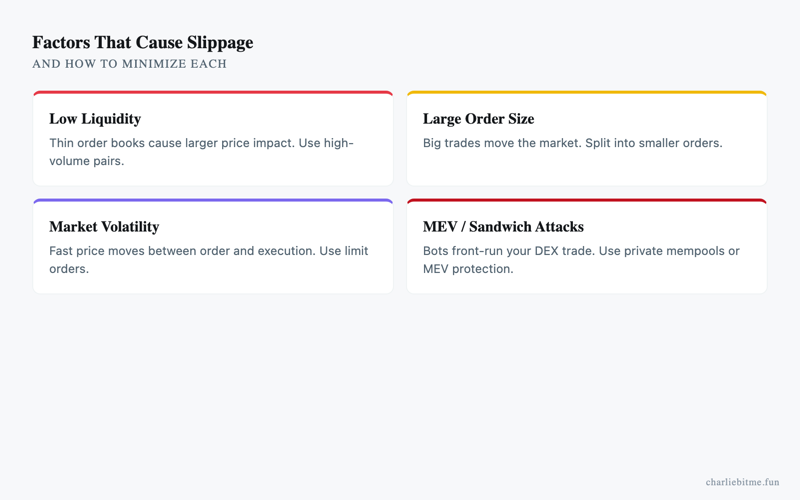
Three factors drive slippage: order book depth, price volatility, and trade size. On a centralized exchange, your market buy order executes against the existing sell orders in the book. If you buy $10,000 of ETH and the order book has $50,000 of sell orders within $1 of the current price, slippage is minimal. If it has only $2,000, your order eats through multiple price levels, paying progressively higher prices.
On decentralized exchanges using automated market makers (AMMs), the mechanism is different but the effect is similar. Uniswap and other AMM-based DEXs use a mathematical formula — typically the constant product formula (x * y = k) — to determine price. Every trade moves the price along the curve. The larger your trade relative to the pool’s total liquidity, the more the price moves against you.
Volatility amplifies slippage because prices change between when you submit a transaction and when it executes. On Ethereum mainnet, a swap transaction may wait 12-30 seconds for block inclusion. During a market crash, the price can move 2-3% in that window. Your transaction executes at the worse price, not the quoted price.
How Does Slippage Work on Automated Market Makers?
AMMs like Uniswap V2 use the constant product formula: x * y = k, where x and y are the reserves of two tokens in the pool, and k is a constant. When you buy token A with token B, you add B to the pool and remove A. The price of A increases because its supply in the pool decreased.
For a pool with $1 million in total liquidity ($500,000 of each token), a $10,000 swap generates approximately 1% price impact. A $50,000 swap generates roughly 5% impact. A $100,000 swap can generate 10% or more. The relationship is not linear — larger trades face exponentially worse prices.
Uniswap V3 introduced concentrated liquidity, which allows liquidity providers to specify price ranges. This concentrates capital where trading actually occurs, reducing slippage for trades within popular ranges. According to Uniswap data, V3 can provide 4,000x better capital efficiency than V2 for in-range trades, dramatically reducing slippage on major pairs like ETH/USDC.
How Do You Reduce Slippage on DEX Swaps?
Five practical strategies reduce the slippage you pay on every trade.
1. Use limit orders instead of market orders. A limit order specifies the maximum price you will pay. On centralized exchanges, limit orders guarantee your execution price. On DEXs, protocols like CoW Swap and 1inch offer limit order functionality that executes at your specified price or not at all.
2. Set slippage tolerance carefully. Every DEX interface includes a slippage tolerance setting. This is the maximum price deviation you accept. Setting it too low (0.1%) causes transactions to fail in volatile markets. Setting it too high (5%+) opens you to sandwich attacks. For major token pairs, 0.3-0.5% is appropriate. For illiquid tokens, 1-3% may be necessary. The Charlie Bit Me team recommends starting at 0.5% and adjusting only if transactions fail.
3. Split large orders. Instead of swapping $50,000 in one transaction, break it into five $10,000 trades. Each smaller trade generates less price impact. DEX aggregators like 1inch and Paraswap automatically split orders across multiple pools and DEXs to minimize total slippage.
4. Trade on high-liquidity venues. The ETH/USDC pool on Uniswap V3 (Ethereum mainnet) holds hundreds of millions in liquidity. The same pair on a small DEX on an obscure chain might hold $100,000. Always check pool liquidity before trading. DefiLlama tracks DEX volume and liquidity across all chains.
5. Avoid trading during extreme volatility. During market crashes or major news events, order books thin out and AMM pools become imbalanced. Slippage spikes. If possible, wait for conditions to normalize. A 30-minute delay after a volatility event can reduce slippage by half or more.
What Are Sandwich Attacks and How Do They Exploit Slippage?
A sandwich attack is a form of maximal extractable value (MEV) where a bot front-runs your DEX trade to profit from the slippage you create. The attack works in three steps: the bot sees your pending transaction in the mempool, buys the token before your trade executes (front-run), and then sells immediately after your trade executes (back-run). Your trade pushes the price up; the bot sells at the inflated price.
According to Flashbots data, MEV extraction on Ethereum has generated billions in cumulative revenue for searchers. Sandwich attacks are the most common form, responsible for a significant portion of MEV activity.
To protect against sandwich attacks: use MEV-protected RPC endpoints like Flashbots Protect or MEV Blocker. These route your transactions through private mempools that are not visible to sandwich bots. Keep slippage tolerance as low as practical — a 0.3% tolerance gives bots less room to extract value than a 5% tolerance. For more on the broader trading landscape, see our guide on dollar cost averaging and spot versus futures trading.
How Much Slippage Is Normal on Different Platforms?
| Platform Type | Typical Slippage (Major Pairs) | Typical Slippage (Small Caps) | MEV Risk |
|---|---|---|---|
| Centralized exchange (Binance, Coinbase) | 0.01-0.05% | 0.1-0.5% | None |
| Uniswap V3 (Ethereum mainnet) | 0.05-0.3% | 1-5% | High without MEV protection |
| Uniswap V3 (Arbitrum/Base) | 0.05-0.3% | 1-3% | Lower (sequencer ordering) |
| Raydium (Solana) | 0.1-0.5% | 2-10% | Moderate |
| Small DEX on new chain | 0.5-2% | 5-20%+ | Varies |
These figures assume trades of $1,000-$10,000. Larger trades face proportionally more slippage, especially on AMM-based DEXs where price impact scales with trade size. Visit the Charlie Bit Me homepage for more trading and research guides. Read our research methodology for how we verify these figures.
Frequently Asked Questions
- Is slippage the same as a trading fee?
- No. Trading fees are fixed percentages charged by the exchange or protocol (0.3% on Uniswap V2, 0.1% on Binance spot). Slippage is the additional cost from price movement during execution. You pay both — the fee plus the slippage.
- Can slippage be positive?
- Yes. Positive slippage occurs when the price moves in your favor between order submission and execution. You receive a better price than expected. This happens less frequently than negative slippage but does occur, especially on limit orders that fill at a better price.
- Why did my DEX transaction fail with a slippage error?
- Your slippage tolerance was set lower than the actual price movement during the transaction. The DEX reverted the transaction to protect you from executing at a worse price than you specified. Increase your tolerance slightly and retry. You still pay the gas fee for the failed transaction on Ethereum.
Sources
- Uniswap V3 Documentation — Concentrated Liquidity — docs.uniswap.org
- Flashbots MEV Data — explore.flashbots.net (checked when I last reviewed)
- DefiLlama DEX Data — defillama.com
- 1inch DEX Aggregator — 1inch.io
This article is for informational purposes only and does not constitute trading advice. Cryptocurrency trading involves substantial risk. Always verify slippage settings before executing trades.