Dollar cost averaging (DCA) is an investment strategy where you buy a fixed dollar amount of Bitcoin on a regular schedule regardless of price. Instead of trying to time market bottoms, DCA investors spread their purchases across weeks or months, reducing the impact of volatility. Historical data shows that a $100 weekly Bitcoin DCA starting from virtually any multi-year window has outperformed savings accounts and most traditional assets.
In This Article
- How Does Dollar Cost Averaging Work for Bitcoin?
- How Does DCA Compare to Lump Sum Investing?
- What Returns Has Bitcoin DCA Produced Historically?
- How Do You Set Up Automatic Bitcoin DCA?
- Should You DCA Into Bitcoin Only or Include Other Cryptocurrencies?
- What Are the Tax Implications of Bitcoin DCA?
- Frequently Asked Questions
- Sources
How Does Dollar Cost Averaging Work for Bitcoin?
DCA eliminates the timing decision entirely. You pick an amount — $50, $100, $500 — and a frequency — weekly, biweekly, or monthly. Then you buy on the same schedule regardless of whether Bitcoin is at $30,000 or $90,000. Over time, you accumulate at an average price that smooths out the peaks and valleys.
When the price drops, your fixed dollar amount buys more Bitcoin. When the price rises, it buys less. This mechanical process naturally weights your purchases toward lower prices. It does not guarantee profit, but it eliminates the risk of investing your entire allocation at a local peak.
According to data from dcabtc.com, a $10 weekly DCA into Bitcoin over the past five years produced a positive return in every rolling three-year period since Bitcoin’s launch. The strategy’s strength is patience, not prediction.
How Does DCA Compare to Lump Sum Investing?
Academic research on traditional markets shows that lump sum investing outperforms DCA roughly two-thirds of the time, because markets trend upward over long periods. Holding cash while DCA-ing means some of your capital misses early gains.
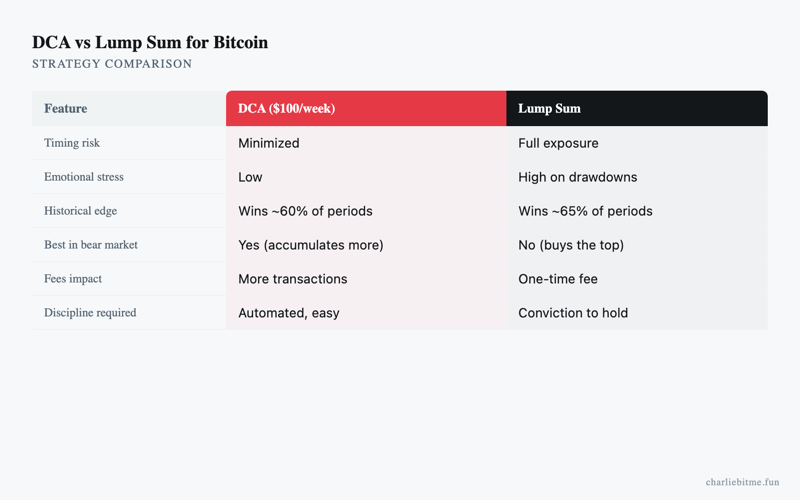
Bitcoin is different from traditional markets in one critical way: its volatility. BTC has historically experienced drawdowns of 50% to 80% within bull-to-bear cycles. A lump sum investment at a cycle top can take years to recover. DCA mitigates this specific risk.
| Strategy | Works Best When | Risk Profile | Psychological Difficulty | Typical Use Case |
|---|---|---|---|---|
| Lump sum | Long time horizon, high conviction | Maximum exposure to short-term drawdowns | Hard — watching a large position drop 50% | Deploying inheritance, windfall, or bonus |
| DCA (weekly) | Uncertain timing, steady income | Reduced exposure to timing risk | Easy — autopilot, emotionally neutral | Regular salary allocation |
| DCA (monthly) | Smaller amounts, long accumulation | Less frequent averaging | Easy — aligns with paycheck cycle | Retirement-style accumulation |
| Value averaging | Active management, price awareness | Buys more when cheap, less when expensive | Moderate — requires judgment calls | Experienced investors only |
My opinion: for most people with regular income and a multi-year horizon, weekly DCA into Bitcoin is the objectively best risk-adjusted approach. It removes emotion from the process. The people who lose money in crypto are overwhelmingly those who buy large amounts at peaks driven by excitement and sell at bottoms driven by fear. DCA prevents both mistakes.
What Returns Has Bitcoin DCA Produced Historically?
Historical performance is not a guarantee of future results. That said, the track record is worth examining. According to data compiled by dcabtc.com and verified against CoinGecko historical pricing:
A $100 weekly DCA into Bitcoin over three years would have been profitable in every three-year window since BTC began trading on exchanges. Even someone who started DCA at the absolute peak of the 2021 bull market — the worst possible timing — saw their position recover and turn profitable within roughly 18 months of continued weekly buying.
The power of DCA is in the drawdowns. When Bitcoin dropped from $69,000 to $16,000 during the 2022 bear market, weekly DCA investors accumulated large positions at deeply discounted prices. Those sub-$20,000 purchases dramatically lowered their average cost and amplified subsequent recovery gains.
For understanding how market cap relates to these price cycles, see our guide on cryptocurrency market cap. For chart-based analysis of price movements, read our candlestick chart guide.
How Do You Set Up Automatic Bitcoin DCA?
Most major exchanges offer recurring purchase features. The setup takes under five minutes.
Coinbase: Navigate to Bitcoin, tap “Buy,” select “Recurring,” choose amount and frequency (daily, weekly, biweekly, monthly). Coinbase charges a spread fee of approximately 0.5% plus a flat transaction fee that varies by amount.
Kraken: Use the “Recurring Buy” feature under the Buy tab. Kraken Pro offers lower fees than the main interface. Fees range from 0.16% to 0.26% for maker/taker orders on Pro.
Strike: Designed specifically for DCA. Supports recurring purchases with fees of approximately 0.3%. Connects directly to your bank account.
Swan Bitcoin: A DCA-focused platform charging 0.99% per purchase for their standard plan. Offers automatic withdrawal to your own wallet — a feature most exchanges do not include.
The fee differences add up over years of DCA. A 1% fee on $100 weekly is $52 per year. A 0.3% fee on the same amount is $15.60. Over a decade, that difference compounds to hundreds of dollars. Choose the lowest-fee option you can access.
Should You DCA Into Bitcoin Only or Include Other Cryptocurrencies?
Bitcoin has the longest track record, the deepest liquidity, and the clearest monetary thesis. For pure DCA — set it and forget it — Bitcoin alone is the simplest and historically most reliable choice.
Adding Ethereum introduces exposure to the smart contract platform economy, which diversifies the thesis but also adds risk. ETH has underperformed BTC in some cycles and outperformed in others.
Adding smaller altcoins to a DCA strategy introduces asymmetric risk. Many altcoins decline 90% or more during bear markets and never recover. DCA into a declining altcoin is a losing strategy. If you DCA into anything beyond Bitcoin and Ethereum, limit it to a small percentage and accept the possibility of total loss.
For evaluating the fundamentals of any cryptocurrency before adding it to your DCA, visit our pillar guide on how to research cryptocurrency. For more on our evaluation methods, see our research methodology.
What Are the Tax Implications of Bitcoin DCA?
Every DCA purchase creates a separate tax lot with its own cost basis and holding period. When you eventually sell, each lot is tracked individually. If you bought weekly for two years, you have over 100 separate tax lots.
According to IRS guidance on virtual currency, the accounting method you choose (FIFO, LIFO, HIFO, specific identification) determines which lots are sold first and therefore your taxable gain. DCA creates a natural advantage for HIFO accounting — you have many lots at different prices and can choose to sell the highest-cost lots first, minimizing gains.
Use crypto tax software like CoinTracker or Koinly to track lots automatically. Manual tracking of 100+ weekly purchases across multiple tax years is impractical and error-prone.
Frequently Asked Questions
- Is weekly or monthly DCA better for Bitcoin?
- Weekly DCA produces slightly better averaging because it samples more price points. The difference over long periods is small — under 5% in most historical comparisons. Choose the frequency that matches your cash flow. Weekly is better mathematically, but monthly is better than skipping weeks because you forgot.
- Should I stop DCA during a bear market?
- No. Bear markets are when DCA provides the most value. Your fixed dollar amount buys significantly more Bitcoin at lower prices, dramatically lowering your average cost. Stopping during a bear market and resuming during a bull market is the opposite of what the strategy is designed to do.
- What is the minimum amount for Bitcoin DCA?
- Most exchanges allow recurring purchases as low as $1 to $10. Bitcoin is divisible to eight decimal places (satoshis), so you do not need to buy a whole coin. A $25 weekly DCA is a perfectly valid starting point that accumulates over $1,300 per year.
- Should I withdraw my DCA Bitcoin to a hardware wallet?
- Yes, for any meaningful amount. Exchanges can freeze accounts, get hacked, or go bankrupt. Withdraw to a hardware wallet you control once your balance exceeds a few hundred dollars. Some platforms like Swan Bitcoin automate this with scheduled withdrawals to your own address.
Sources
- dcabtc.com — Bitcoin DCA Calculator (accessed when I last checked)
- CoinGecko — Bitcoin Historical Price Data (accessed when I last checked)
- IRS — FAQ on Virtual Currency Transactions (accessed when I last checked)
- Vanguard Research — Dollar-Cost Averaging vs. Lump Sum Investing (accessed when I last checked)
This article is for informational and educational purposes only. It does not constitute financial or investment advice. Cryptocurrency investments carry substantial risk, including the risk of total loss. Past performance does not guarantee future results.