Spot trading means buying cryptocurrency and owning it outright. Futures trading means betting on the future price of a cryptocurrency using a contract, often with leverage. Spot trading carries no liquidation risk and suits most investors. Futures trading amplifies both gains and losses and is strictly for experienced traders who understand margin, funding rates, and forced liquidation mechanics.
In This Article
- How Does Spot Trading Work in Crypto?
- How Does Futures Trading Work in Crypto?
- What Is the Difference Between Spot and Futures in Practice?
- What Are Funding Rates and Why Do They Matter?
- What Is Liquidation Risk and How Does It Affect Futures Traders?
- Which Should a Beginner Choose — Spot or Futures?
- Frequently Asked Questions
- Sources
How Does Spot Trading Work in Crypto?
Spot trading is the direct purchase of a cryptocurrency at its current market price. When you buy 1 ETH on Coinbase for $3,200, you own that ETH immediately. It sits in your wallet. You can transfer it, stake it, or hold it indefinitely. Your maximum loss is the amount you paid — your position cannot go below zero.
Spot markets exist on centralized exchanges like Binance, Coinbase, and Kraken, and on decentralized exchanges like Uniswap and Raydium. The price you see is the “spot price” — what the asset trades for right now. Settlement is near-instant on centralized platforms and takes one block confirmation on decentralized ones.
Spot trading generates taxable events when you sell. According to IRS guidance, selling cryptocurrency for fiat currency or exchanging one crypto for another are dispositions subject to capital gains tax. Your gain or loss is calculated from your cost basis at purchase.
How Does Futures Trading Work in Crypto?
Futures trading involves contracts that derive their value from an underlying cryptocurrency. You do not own the asset itself. Instead, you hold a position — long (betting the price rises) or short (betting it falls) — that pays or costs the difference between your entry price and exit price, multiplied by your leverage.
On Binance Futures, you can open a Bitcoin long position with 10x leverage using $1,000 of margin. This gives you exposure equivalent to $10,000 worth of Bitcoin. A 5% price increase earns you $500 (50% return on margin). A 10% price decrease triggers liquidation — you lose your entire $1,000.
Perpetual futures are the dominant contract type in crypto. Unlike traditional dated futures that expire on a set date, perpetual contracts have no expiry. They use a funding rate mechanism to keep the contract price aligned with the spot price. When funding is positive, longs pay shorts. When negative, shorts pay longs.
What Is the Difference Between Spot and Futures in Practice?
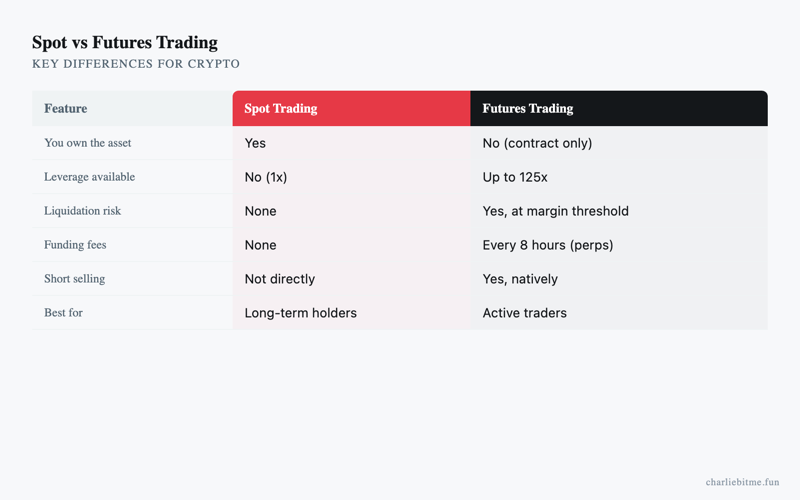
The core difference is ownership versus exposure. Spot gives you the asset. Futures give you a leveraged bet on price movement. Everything else — risk, cost, complexity, tax treatment — flows from that distinction.
| Feature | Spot Trading | Futures Trading |
|---|---|---|
| Asset ownership | Yes — you hold the actual crypto | No — you hold a contract |
| Maximum loss | 100% of investment (asset goes to zero) | 100% of margin (liquidation) |
| Leverage available | None (1x only) | Up to 125x on some platforms |
| Liquidation risk | None | Yes — forced closure at margin threshold |
| Funding costs | None | Ongoing funding rate payments |
| Can go short | No (without margin borrowing) | Yes — natively |
| Staking/yield | Available on held assets | Not available |
| Settlement | Immediate asset delivery | Cash-settled (usually USDT) |
| Complexity | Low | High |
| Best for | Investors, beginners, HODLers | Experienced traders, hedgers |
What Are Funding Rates and Why Do They Matter?
Funding rates are periodic payments exchanged between long and short traders on perpetual futures contracts. They exist to keep the perpetual contract price anchored to the spot price. Exchanges like Binance and Bybit typically charge funding every 8 hours.
When the market is bullish and more traders are long, the funding rate turns positive. Longs pay shorts. This cost compounds quickly. A 0.01% funding rate per 8-hour interval equals 0.03% per day — roughly 11% annually. During euphoric markets, funding rates can spike to 0.1% or higher per interval, making leveraged longs extremely expensive to hold.
Funding rates are publicly visible. Coinglass tracks real-time funding across exchanges. Professional traders monitor funding to gauge market sentiment and avoid entering positions when holding costs are high. For an introduction to reading price charts that inform these decisions, see our guide on reading crypto candlestick charts.
What Is Liquidation Risk and How Does It Affect Futures Traders?
Liquidation is the forced closure of your futures position when losses consume your margin. Every leveraged position has a liquidation price — the level at which the exchange automatically closes your trade to prevent the loss from exceeding your deposited margin.
At 10x leverage, a 10% adverse move liquidates your position. At 50x leverage, a 2% move does. At 125x leverage, a price move of less than 1% triggers liquidation. The higher the leverage, the closer the liquidation price sits to your entry.
According to Coinglass liquidation data, billions of dollars in futures positions are liquidated during major market moves. In a single day of high volatility, $500 million to $1 billion in liquidations is common. These cascading liquidations amplify price swings — a feedback loop that makes crypto futures markets more volatile than spot.
My clear recommendation: do not use leverage above 3x unless you have extensive trading experience and a defined risk management system. The majority of retail futures traders lose money. The exchanges profit from liquidations through their insurance funds.
Which Should a Beginner Choose — Spot or Futures?
Spot trading. Without exception. Beginners should build a portfolio through spot purchases before considering futures. The reasons are straightforward: no liquidation risk, no funding costs, no margin calls, and the ability to hold through volatility without forced exits.
Futures serve three legitimate purposes: hedging an existing spot position against downside, short selling during confirmed downtrends, and professional market-making strategies. None of these apply to someone learning the market. To understand broader market dynamics before trading, read about how crypto market cycles work.
The Charlie Bit Me research team reviews trading mechanics across exchanges and protocols. For details on our verification process, read our research methodology.
Frequently Asked Questions
- Can I trade futures on a decentralized exchange?
- Yes. Platforms like Hyperliquid, dYdX, and GMX offer decentralized perpetual futures. These operate with on-chain settlement and do not require KYC. Liquidation mechanics are similar to centralized platforms, but execution depends on blockchain throughput.
- Are futures profits taxed differently than spot trading profits?
- In the United States, crypto futures gains are generally taxed as capital gains. However, some regulated futures contracts may qualify for the 60/40 tax treatment under IRC Section 1256, where 60% of gains are taxed as long-term regardless of holding period. Consult a tax professional for your specific situation.
- What is cross margin versus isolated margin?
- Cross margin shares your entire account balance as collateral for all open positions. Isolated margin restricts collateral to the amount assigned to a specific position. Isolated margin limits your loss to the allocated amount; cross margin can result in losing your full account balance.
- Can I lose more than my initial deposit trading crypto futures?
- On most crypto exchanges, no. They use auto-deleveraging and insurance funds to prevent negative balances. Some exchanges explicitly offer “no negative balance” protection. On unregulated platforms, the risk may exist — always check the exchange’s terms.
Sources
- IRS Virtual Currency FAQ — irs.gov
- Coinglass Funding Rate Data — coinglass.com (checked when I last reviewed)
- Coinglass Liquidation Data — coinglass.com
- Binance Futures Documentation — binance.com
This article is for informational purposes only and does not constitute financial or trading advice. Futures trading involves substantial risk of loss. Never trade with money you cannot afford to lose.