
Yes, you pay taxes on crypto airdrops in the United States. The IRS treats airdropped tokens as ordinary income, taxable at their fair market value the moment you gain dominion and control over them. This applies whether you requested the airdrop, earned it through protocol activity, or received it passively. Revenue Ruling 2019-24 is the primary IRS guidance that establishes this treatment.
In This Article
- What Does the IRS Say About Crypto Airdrop Taxes?
- When Exactly Is the Tax Triggered on an Airdrop?
- How Is Fair Market Value Determined for Airdropped Tokens?
- How Do You Report Airdrop Income on Your Tax Return?
- What Is the Difference Between an Airdrop and a Hard Fork for Tax Purposes?
- Frequently Asked Questions
- Sources
What Does the IRS Say About Crypto Airdrop Taxes?
The IRS issued Revenue Ruling 2019-24 to address both hard forks and airdrops. The ruling states that when a taxpayer receives cryptocurrency from an airdrop, the fair market value of the tokens at the time of receipt is ordinary income. This income is reported on Schedule 1 (Form 1040) as “Other Income.”
The ruling specifically addresses the “dominion and control” test. You owe taxes when you have the ability to transfer, sell, or otherwise dispose of the tokens — not necessarily when the airdrop is announced. If tokens land in a wallet you control, you have dominion and control. If they are distributed to a smart contract that requires you to claim them, the tax obligation may begin when you execute the claim transaction.
The tax rate depends on your ordinary income tax bracket. For high earners, this means airdrop income could face federal rates up to 37% plus applicable state taxes. There is no preferential capital gains rate for airdrop income — it is treated identically to wages or freelance earnings.
When Exactly Is the Tax Triggered on an Airdrop?
The taxable moment depends on how the airdrop is delivered. Three common scenarios create different timing:
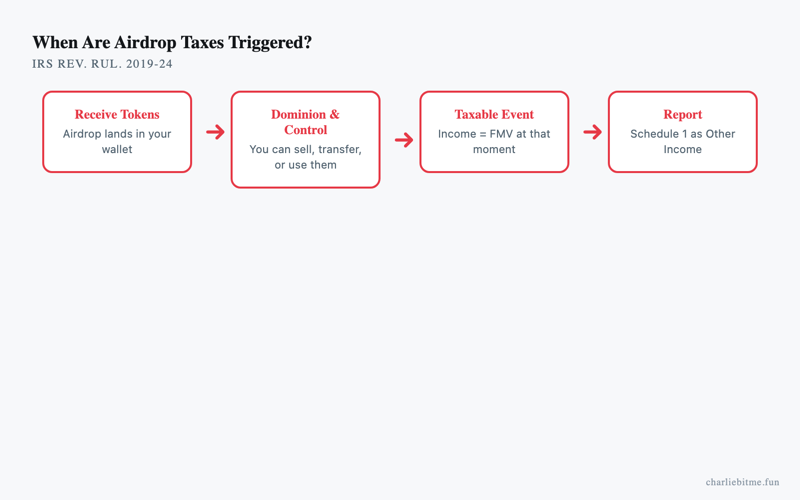
Automatic distribution: Tokens appear in your wallet without any action on your part. Tax is triggered when the tokens arrive and you can access them. If the blockchain records the deposit at 3:00 PM on a Tuesday, that is the taxable moment. The fair market value at that time determines your income.
Claim-required distribution: Many modern airdrops (Uniswap, Arbitrum, Jupiter) require users to visit a claim page and execute a transaction. The IRS has not issued specific guidance on whether the taxable event occurs when tokens become claimable or when you actually claim them. Most tax professionals advise using the claim date as the taxable moment, since that is when you exercise dominion and control.
Vested or locked distributions: Some airdrops deliver tokens with transfer restrictions or vesting schedules. Tokens you cannot sell or transfer arguably are not under your dominion and control. Tax may be deferred until the restrictions lift. This is an area of genuine ambiguity — consult a tax professional for locked airdrop situations.
| Delivery Method | Taxable Moment | Fair Market Value Basis | Certainty |
|---|---|---|---|
| Auto-deposited, immediately transferable | When tokens arrive in wallet | Price at deposit timestamp | High |
| Claim required | When you claim (most conservative) | Price at claim transaction | High |
| Vested/locked tokens | When restrictions lift (arguable) | Price when transferable | Low — legal gray area |
| Hard fork (new chain) | When you can access new-chain tokens | Price at first access | High (per Rev. Rul. 2019-24) |
How Is Fair Market Value Determined for Airdropped Tokens?
Fair market value (FMV) is the price at which the token trades on an exchange at the time you receive it. For tokens listed on major exchanges like Coinbase, Binance, or Uniswap, the FMV is straightforward — check the trading price at the timestamp of receipt.
For tokens that are not yet trading when distributed, FMV is harder to establish. Some projects conduct airdrops before any exchange listing. In this case, you may use the first available trading price, an OTC price, or argue that the FMV is zero at time of receipt (with the full amount recognized when traded). The IRS has not provided clear guidance on this edge case.
My recommendation: use the first verifiable market price within 24 hours of receiving the tokens. If no market exists, document that fact and consider reporting a nominal value with a note in your records. Being consistent and documented matters more than being aggressive or conservative. For the full tax reporting process, see our crypto tax guide.
How Do You Report Airdrop Income on Your Tax Return?
Report airdrop income in two places on your federal tax return:
Step 1: Report the FMV of the airdropped tokens as ordinary income on Schedule 1 (Form 1040), Line 8z — “Other income.” Describe it as “Cryptocurrency airdrop income.” This amount is added to your adjusted gross income.
Step 2: When you later sell the airdropped tokens, report the capital gain or loss on Form 8949. Your cost basis is the FMV you reported as income on the date of receipt. If you received tokens valued at $5,000 and later sold them for $8,000, you have a $3,000 capital gain. If you sold for $2,000, you have a $3,000 capital loss.
Keep detailed records: the token name, amount received, date received, FMV at receipt, the transaction hash, and any claim transaction details. Crypto tax software like Koinly and CoinTracker can track airdrops automatically if your wallets are connected.
What Is the Difference Between an Airdrop and a Hard Fork for Tax Purposes?
Revenue Ruling 2019-24 addresses both situations but treats them identically: both are ordinary income when you gain dominion and control. The practical difference is how tokens arrive.
A hard fork creates a new blockchain. Existing holders of the original chain automatically receive tokens on the new chain. Bitcoin Cash (BCH) from the Bitcoin hard fork is the classic example. You owe income tax on the FMV of the new-chain tokens when you first have the ability to dispose of them — which typically means when an exchange supports withdrawals or when a wallet supports the new chain.
An airdrop distributes new tokens on an existing blockchain. Uniswap’s UNI airdrop, Arbitrum’s ARB airdrop, and Jupiter’s JUP airdrop are examples. These may reward past activity, protocol usage, or simply holding a specific token.
For tax reporting, the mechanics are identical. Both are ordinary income at FMV upon receipt. The cost basis for future sales is that same FMV. See related guides on calculating crypto cost basis and tax loss harvesting strategies for managing your tax position. Read our research methodology for how we verify IRS requirements.
Frequently Asked Questions
- What if I receive an airdrop of a worthless token?
- If the token has no trading market and no verifiable value at the time of receipt, the fair market value is arguably zero. You would not owe income tax at receipt. However, if the token later gains value and you sell it, the entire sale amount would be a capital gain since your cost basis is zero.
- Do I owe taxes on an airdrop I did not claim?
- If you have not claimed the tokens and they remain in a smart contract, you likely do not have dominion and control and therefore do not owe taxes. However, if tokens were automatically deposited in a wallet you control, you may owe taxes even if you are unaware of the deposit.
- Are airdrops subject to self-employment tax?
- Generally no, unless you are in the business of “airdrop farming” as a trade or business. For most individual recipients, airdrop income is other income on Schedule 1, not self-employment income on Schedule C. The distinction is fact-specific.
- How do other countries tax crypto airdrops?
- Tax treatment varies. The UK treats airdrops as income if received in return for a service, but not if received without doing anything. Australia taxes airdrops as ordinary income. Germany may exempt airdrops held over one year. Always check your local tax authority’s guidance.
Sources
- IRS Revenue Ruling 2019-24 — irs.gov (checked when I last reviewed)
- IRS Form 8949 Instructions — irs.gov
- IRS Virtual Currency FAQ — irs.gov
This article is for informational purposes only and does not constitute tax or legal advice. Consult a qualified tax professional regarding your specific situation. Tax laws change frequently and may vary by jurisdiction.