
Crypto tax loss harvesting is the practice of selling cryptocurrency at a loss to offset capital gains and reduce your tax bill. Because the IRS wash sale rule does not currently apply to cryptocurrency, you can sell at a loss and immediately repurchase the same asset — a strategy unavailable with stocks or securities. This makes crypto one of the most tax-efficient asset classes for active loss harvesting.
In This Article
- What Is Tax Loss Harvesting and How Does It Work for Crypto?
- Does the Wash Sale Rule Apply to Cryptocurrency?
- How Do You Execute a Crypto Tax Loss Harvesting Strategy Step by Step?
- What Are the IRS Limitations on Deducting Crypto Losses?
- Which Tracking Tools Work Best for Crypto Tax Loss Harvesting?
- How Does Tax Loss Harvesting Interact With DeFi and Staking?
- Frequently Asked Questions
- Sources
What Is Tax Loss Harvesting and How Does It Work for Crypto?
Tax loss harvesting means deliberately selling an asset that has declined in value to realize a capital loss on paper. You then use that loss to offset capital gains from other trades. If your losses exceed your gains, the IRS allows you to deduct up to $3,000 per year against ordinary income, with the remainder carried forward to future tax years.
For cryptocurrency specifically, this strategy is powerful because digital assets experience significant price volatility. A Bitcoin position purchased at $60,000 that drops to $45,000 represents a $15,000 harvestable loss — even if you believe the price will recover. You sell, book the loss, and buy back immediately.
According to the IRS, cryptocurrency is treated as property under Notice 2014-21. This classification is what makes the wash sale loophole possible. The wash sale rule under IRC Section 1091 applies to “stock or securities” — and the IRS has not extended it to digital assets as of when I last checked.
Does the Wash Sale Rule Apply to Cryptocurrency?
The wash sale rule currently does not apply to cryptocurrency. This is the single biggest advantage crypto holders have when tax loss harvesting. The rule prohibits claiming a loss if you repurchase a “substantially identical” security within 30 days before or after the sale. Since crypto is classified as property — not a security — the rule does not trigger.
This means you can sell Bitcoin at a loss at 10:00 AM and repurchase Bitcoin at 10:01 AM. The loss is fully deductible. With stocks, you would need to wait 31 days or buy a different asset.
Congress has proposed extending the wash sale rule to digital assets in multiple bills, including provisions in prior infrastructure legislation. The Tax Cuts and Jobs Act extension discussions have included crypto wash sale provisions. When this eventually passes — and most tax professionals expect it will — the window closes permanently. Smart investors are harvesting aggressively now while the opportunity exists.
How Do You Execute a Crypto Tax Loss Harvesting Strategy Step by Step?
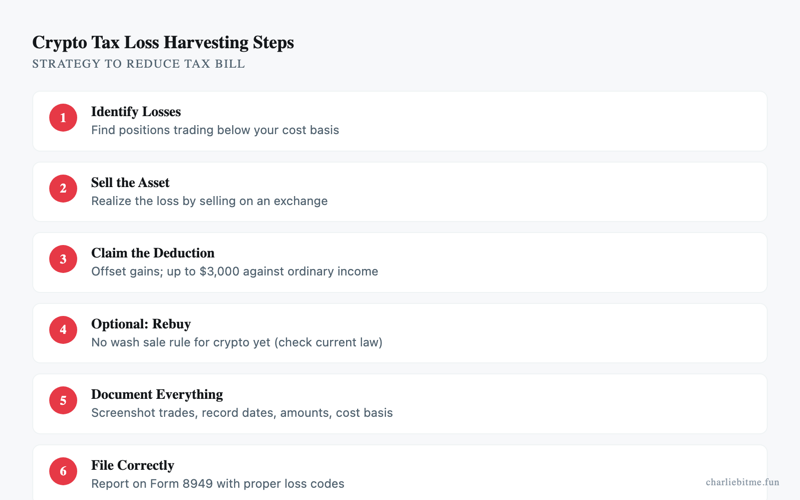
A structured approach prevents mistakes that could void your deductions. Follow these five steps:
Step 1: Identify losing positions. Review your portfolio for any asset trading below your cost basis. Check each tax lot individually — you may have bought ETH at $3,800 in one transaction and $2,400 in another. Only the first lot has a harvestable loss if ETH trades at $3,000.
Step 2: Calculate the loss amount. Subtract the current fair market value from your cost basis. Include any transaction fees in your cost basis, as these increase your basis and therefore your deductible loss.
Step 3: Execute the sale. Sell the losing position on the exchange where you hold it. Document the exact time, price, and amount. Keep the transaction confirmation.
Step 4: Repurchase immediately (optional). If you want to maintain your position, buy back the same asset right away. Your new cost basis resets to the repurchase price. There is no mandatory waiting period for crypto.
Step 5: Record everything. Log the sale, the loss amount, the repurchase, and the new cost basis. You will report realized losses on IRS Form 8949 and carry the totals to Schedule D. Read our methodology for how we verify tax reporting requirements.
What Are the IRS Limitations on Deducting Crypto Losses?
The IRS caps the annual deduction for net capital losses at $3,000 for single filers and married filing jointly, or $1,500 for married filing separately. Losses beyond this threshold carry forward indefinitely until fully used. There is no expiration on the carryforward.
Short-term losses offset short-term gains first. Long-term losses offset long-term gains first. Any remaining net loss then offsets the other category. This ordering matters because short-term gains are taxed at ordinary income rates (up to 37%), while long-term gains face lower rates (0%, 15%, or 20%).
| Loss Type | Offsets First | Then Offsets | Annual Cap | Carryforward |
|---|---|---|---|---|
| Short-term capital loss | Short-term gains (up to 37%) | Long-term gains, then ordinary income | $3,000 | Unlimited years |
| Long-term capital loss | Long-term gains (0-20%) | Short-term gains, then ordinary income | $3,000 | Unlimited years |
One critical limitation: you cannot harvest losses on assets you transfer to a different wallet without selling. Moving Bitcoin from Coinbase to a Ledger hardware wallet is not a taxable event. You must actually sell to realize the loss.
Which Tracking Tools Work Best for Crypto Tax Loss Harvesting?
Manual spreadsheets fail at scale. Dedicated crypto tax software automates cost basis tracking across exchanges and wallets, identifies harvestable losses in real time, and generates the IRS forms you need.
Koinly flags unrealized losses across your connected wallets and exchanges. CoinTracker includes a dedicated tax loss harvesting dashboard that shows opportunity by asset. TaxBit provides institutional-grade tracking with real-time gain/loss calculations. All three support CSV imports from major exchanges and direct API connections.
My honest assessment: CoinTracker has the best harvesting-specific interface for individual investors. It shows exactly how much you can save and which assets to sell. Koinly is better for DeFi-heavy portfolios with complex transaction types. For a deeper look at the full tax reporting process, see our comprehensive crypto tax guide.
How Does Tax Loss Harvesting Interact With DeFi and Staking?
DeFi positions add complexity. Providing liquidity to a Uniswap pool, for example, involves depositing two tokens. If you remove liquidity at a loss, that loss is harvestable. However, the cost basis calculation for LP tokens requires tracking the value of both underlying assets at deposit and withdrawal. This is where most people make errors.
Staking rewards are taxed as ordinary income when received, according to IRS guidance. If a staking reward token later declines in value, you can harvest that loss. Your cost basis is the fair market value at the time you received the reward. See our guide on whether DEX swaps create taxable events and how to report DeFi income on your taxes.
Frequently Asked Questions
- Can I harvest losses on crypto I bought years ago?
- Yes. There is no time limit on when you can harvest a loss. If you bought Ethereum in 2021 and it is still below your purchase price, you can sell to realize the loss at any time. The holding period determines whether it is a short-term or long-term loss.
- Do I need to report crypto losses if I do not owe taxes?
- Yes. All cryptocurrency dispositions must be reported on Form 8949 regardless of whether you have a net gain or loss. Unreported losses cannot be carried forward, and failing to report is a compliance risk even if no tax is owed.
- Will the wash sale rule eventually apply to crypto?
- Most tax professionals expect Congress to extend the wash sale rule to digital assets within the next few years. Multiple legislative proposals have included this provision. When it passes, you will need to wait 31 days before repurchasing the same cryptocurrency after a loss sale.
- Can I harvest losses on NFTs?
- Yes. NFTs are treated as property by the IRS. If an NFT has declined below your purchase price, selling it realizes a deductible capital loss. The same $3,000 annual net loss cap applies.
Sources
- IRS Notice 2014-21 — irs.gov (checked when I last reviewed)
- IRS Form 8949 Instructions — irs.gov
- IRS Virtual Currency FAQ — irs.gov
- IRC Section 1091 (wash sale rule) — law.cornell.edu
This article is for informational purposes only and does not constitute tax advice. Consult a qualified tax professional before implementing a tax loss harvesting strategy. Cryptocurrency investments carry significant risk, including the risk of total loss.