DeFi income from lending, liquidity pools, yield farming, and airdrops is taxable in the United States, and the IRS expects you to report it on your federal tax return. The challenge is that DeFi generates dozens of taxable events across multiple protocols, often without any 1099 form. This guide covers how the IRS classifies each type of DeFi income, which tax forms to use, and practical strategies for keeping records when protocols do not provide them.
In This Article
DeFi tax reporting is the most complex area of cryptocurrency taxation. If you are new to crypto taxes in general, start with our complete guide to how the IRS taxes cryptocurrency. The rules below apply specifically to decentralized finance activities.
How Does the IRS Classify DeFi Income?
The IRS treats most DeFi income as ordinary income taxed at your regular rate, but some DeFi activities also trigger capital gains events. The classification depends on what the protocol pays you and how you received it. Interest-like rewards are ordinary income. Token swaps create capital gains or losses.
| DeFi Activity | Tax Classification | When Taxed | Rate | Form |
|---|---|---|---|---|
| Lending interest (Aave, Compound) | Ordinary income | When received | 10-37% | Schedule 1 / Schedule C |
| Liquidity pool fees | Ordinary income + capital gains on rebalancing | When received / when withdrawn | Mixed | Schedule 1 + Schedule D |
| Yield farming rewards | Ordinary income | When tokens enter your wallet | 10-37% | Schedule 1 / Schedule C |
| Airdrops from DeFi protocols | Ordinary income | When you gain dominion and control | 10-37% | Schedule 1 |
| Token swaps (DEX trades) | Capital gains/losses | At the time of each swap | 0-20% (long) or ordinary (short) | Form 8949 + Schedule D |
| Governance token rewards | Ordinary income | When received | 10-37% | Schedule 1 |
According to IRS Virtual Currency FAQ, cryptocurrency received as payment for services — including DeFi protocol rewards — is taxable as ordinary income at fair market value on the date received. This applies regardless of whether the protocol issues a 1099.
How Do You Report DeFi Lending Income?
Report DeFi lending interest on Schedule 1 (Additional Income) if it is passive, or on Schedule C if you operate lending as a business. The fair market value of each interest payment at the time it enters your wallet is your taxable income. You do not wait until you sell the tokens.
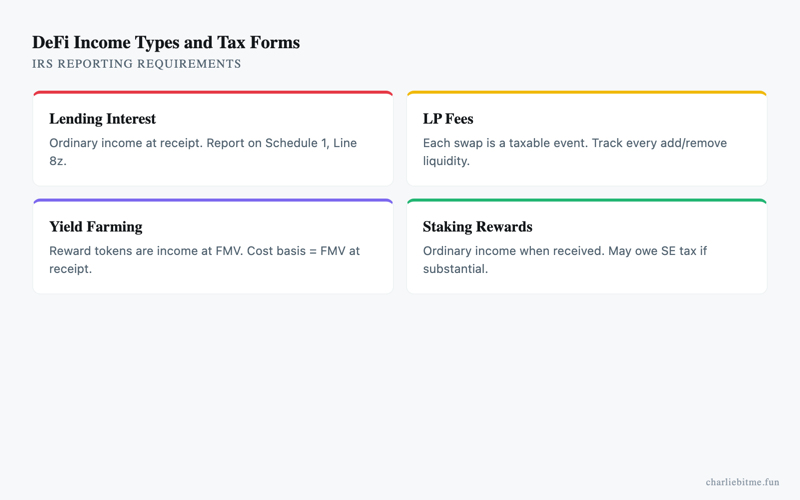
Protocols like Aave and Compound pay interest continuously by increasing your aToken or cToken balance. Each balance increase is technically a taxable event. In practice, most tax software calculates this as a daily accrual and reports the total for the year.
The cost basis of interest tokens is the fair market value at the time you received them. When you later sell those tokens, you owe capital gains tax on any appreciation above that basis. This creates a double taxation effect — income tax when received, then capital gains when sold.
What Makes Liquidity Pool Taxes So Complicated?
Liquidity pools create three separate tax events: the initial deposit (potential swap), fee income earned while providing liquidity, and the withdrawal (potential gain or loss from impermanent loss and price changes). This makes LP positions among the most difficult DeFi activities to track for tax purposes.
When you deposit ETH and USDC into a Uniswap pool, the protocol rebalances your position continuously. According to tax guidance from firms like CoinTracker, the prevailing conservative interpretation is that depositing into an LP and receiving LP tokens is a taxable exchange. The withdrawal is another taxable event.
Fee income earned from the pool is ordinary income, valued at the time it accrues to your position. If you experience impermanent loss, that loss is only realized when you withdraw. The IRS has not issued specific guidance on impermanent loss, but most practitioners treat it as a capital loss upon withdrawal.
If you are also providing liquidity to earn staking rewards, those add another layer of taxable events on top of the LP complexity.
How Do You Calculate Cost Basis for DeFi Transactions?
Use the fair market value of each token at the exact time of each transaction as your cost basis. For DeFi, this means capturing prices at potentially hundreds of transaction timestamps across multiple protocols and chains. Manual tracking is impractical — you need either a crypto tax software tool or meticulous spreadsheet discipline.
The IRS allows FIFO (first in, first out), LIFO (last in, first out), or specific identification for cost basis methods. FIFO is the default if you do not elect otherwise. For a detailed breakdown of cost basis methods, see our guide on calculating cost basis for crypto trades.
My opinion: specific identification is the most tax-efficient method for active DeFi users because it lets you choose which lots to sell. However, it requires you to maintain complete records of every acquisition. If your records are incomplete, FIFO is the safest default to avoid IRS disputes.
Which Tax Software Handles DeFi Best?
CoinTracker, Koinly, and TokenTax support the broadest range of DeFi protocols, with direct wallet address imports that automatically categorize transactions. No software handles every edge case perfectly, but they eliminate the manual work of tracking hundreds of transactions.
According to Koinly’s DeFi support page, their platform integrates with over 20 DeFi protocols directly and supports generic wallet imports for chains including Ethereum, BSC, Polygon, Arbitrum, and Solana. CoinTracker provides similar coverage and integrates directly with TurboTax.
All three platforms cost between $50 and $200 per year depending on transaction volume. Given the alternative is manual calculation of potentially thousands of taxable events, the cost is justified for any active DeFi user.
Read about how we verify tax-related claims in our research methodology.
Frequently Asked Questions
- Do DeFi protocols send 1099 forms?
- Most do not. Decentralized protocols have no legal entity obligated to issue tax forms. You are responsible for reporting all income regardless of whether you receive a 1099. Some centralized DeFi interfaces may issue 1099s if they operate as US entities.
- Can I deduct gas fees on DeFi transactions?
- Gas fees paid to execute DeFi transactions can be added to your cost basis (increasing the cost of acquisition) or subtracted from proceeds (reducing the sale amount). This reduces your taxable gain. Keep records of every gas fee with the associated transaction.
- What if I cannot track all my DeFi transactions?
- Use crypto tax software that imports directly from wallet addresses. If transactions are still missing, document your best-effort calculation. The IRS expects reasonable record-keeping, and demonstrating a good-faith effort is better than not reporting at all.
- Is moving tokens between my own wallets a taxable event?
- No. Transferring crypto between wallets you own is not a taxable event. However, bridging to a different token or depositing into a protocol that gives you a different token back may be treated as a taxable exchange.
Sources
- IRS Virtual Currency FAQ — accessed when I last checked
- IRS Form 8949 Instructions — accessed when I last checked
- Koinly DeFi Tax Support — accessed when I last checked
- CoinTracker — accessed when I last checked
This article is for informational and educational purposes only. It does not constitute tax or financial advice. Tax laws change frequently. Consult a qualified tax professional for advice specific to your situation.