
Yes, swapping one cryptocurrency for another on a decentralized exchange is a taxable event in the United States. The IRS treats every crypto-to-crypto swap as a disposition of the first token and an acquisition of the second. You owe capital gains tax on the difference between your cost basis in the token you gave up and its fair market value at the time of the swap, regardless of whether you converted to dollars.
In This Article
- Why Does the IRS Consider a DEX Swap Taxable?
- How Do You Calculate the Tax on a DEX Swap?
- How Does DEX Tax Reporting Differ From CEX Reporting?
- What About Liquidity Pool Deposits and Withdrawals?
- How Do You Track DEX Swaps for Tax Purposes?
- Does the Like-Kind Exchange Exemption Apply to Crypto Swaps?
- Frequently Asked Questions
- Sources
Why Does the IRS Consider a DEX Swap Taxable?
The IRS classifies cryptocurrency as property under Notice 2014-21. When you exchange one property for another, you realize a gain or loss on the property you give up. A swap of ETH for USDC on Uniswap is no different in tax treatment from selling ETH for dollars on Coinbase. The form of the transaction does not matter. The economic substance does.
This applies to every type of token swap: ERC-20 to ERC-20, ETH to any token, stablecoin to stablecoin, and cross-chain swaps through bridges. There is no exemption for decentralized platforms. The IRS does not distinguish between centralized and decentralized exchanges.
For a broader overview, see our IRS cryptocurrency tax guide. To understand cost basis calculations for these swaps, read how to calculate cost basis for crypto trades.
How Do You Calculate the Tax on a DEX Swap?
The calculation follows the same capital gains formula as any crypto sale. You need two numbers: your cost basis in the token you are giving up, and the fair market value of what you receive.
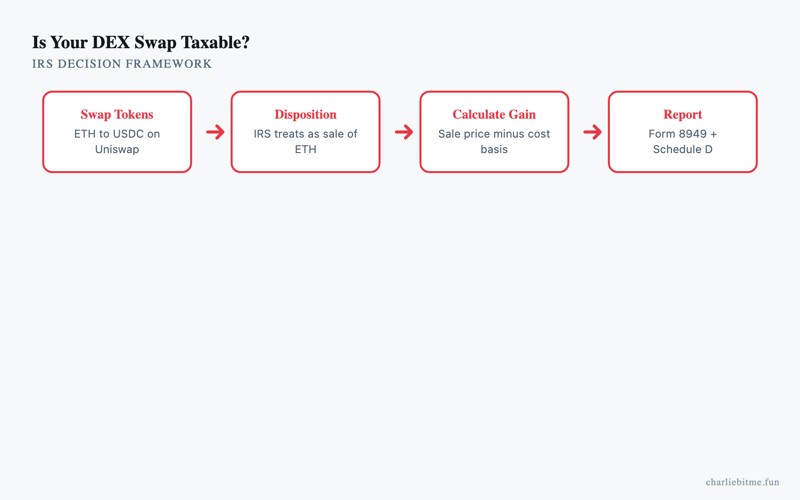
Example: You bought 1 ETH at $2,000. Six months later, you swap that 1 ETH for 3,200 USDC on Uniswap. The fair market value of 1 ETH at swap time is $3,200.
Capital gain: $3,200 (fair market value at swap) minus $2,000 (cost basis) = $1,200 taxable gain. The cost basis of your new 3,200 USDC is $3,200 (the fair market value at the time of acquisition).
Gas fees paid for the swap — in this case, ETH spent on the Uniswap transaction — may be added to your cost basis or treated as a separate disposition. Tax guidance on gas fee treatment is still developing, but most tax professionals and software treat gas as an additional cost of the transaction.
How Does DEX Tax Reporting Differ From CEX Reporting?
The tax obligation is identical. The reporting burden is not. Centralized exchanges like Coinbase and Kraken issue 1099 forms and provide transaction history downloads. Decentralized exchanges do not report to the IRS and do not issue tax forms.
| Factor | Centralized Exchange (CEX) | Decentralized Exchange (DEX) |
|---|---|---|
| IRS reporting | 1099 forms issued (starting tax year 2025 for some) | No reporting to IRS |
| Transaction records | CSV export available in-app | Must pull from blockchain explorer |
| Fair market value | Listed on the receipt/trade confirmation | Must determine from oracle/DEX price at block timestamp |
| Gas fees | Included in exchange fee | Separate on-chain transaction — must track independently |
| Tax software support | Direct API integration | Wallet address import reads on-chain data |
| Audit trail | Exchange maintains records | Immutable on blockchain but harder to interpret |
The absence of a 1099 does not mean the transaction is invisible. The IRS has contracted with blockchain analytics firms including Chainalysis, CipherTrace, and Elliptic to trace on-chain transactions. According to IRS Digital Assets guidance, taxpayers must report all digital asset transactions regardless of whether they receive a tax form.
What About Liquidity Pool Deposits and Withdrawals?
Providing liquidity on a DEX like Uniswap or Curve introduces additional tax complexity. When you deposit tokens into a liquidity pool and receive LP tokens in return, many tax professionals treat this as a taxable exchange — you disposed of the underlying tokens and received new LP tokens.
When you withdraw, the reverse occurs. You dispose of LP tokens and receive the underlying tokens back, potentially in different ratios due to impermanent loss. Each step may trigger a separate taxable event.
My opinion: this is the area where crypto tax law is most unsettled. The IRS has not published specific guidance on LP tokens. The safest approach is to treat every pool entry and exit as a taxable event and report accordingly. Aggressive positions that treat LP deposits as non-taxable transfers may be defensible, but they carry audit risk.
How Do You Track DEX Swaps for Tax Purposes?
Manual tracking is impractical for active DeFi users. A single Uniswap interaction can involve multiple token transfers, approval transactions, and gas payments in a single block.
Step 1: Use crypto tax software that reads on-chain data. Koinly, CoinTracker, and TokenTax all support wallet address imports. You paste your Ethereum, Solana, or other wallet address, and the software reads every transaction from the blockchain.
Step 2: Review flagged transactions. Automated software misclassifies some DeFi interactions — bridge transactions, contract interactions, and multi-hop swaps frequently need manual correction.
Step 3: Export Form 8949 data. The software generates the IRS-required format. Review it before filing.
For staking reward income that feeds into these swaps, see our guide on staking reward taxation. Our research methodology explains how we evaluate tax software tools.
Does the Like-Kind Exchange Exemption Apply to Crypto Swaps?
No. Section 1031 like-kind exchanges were limited to real property by the Tax Cuts and Jobs Act of 2017. Before that date, some taxpayers argued that crypto-to-crypto swaps qualified for like-kind treatment. The IRS has not accepted this argument for any tax year, and the legal basis was eliminated entirely for transactions after December 31, 2017.
Every crypto-to-crypto swap after that date is a fully taxable disposition. There is no legal mechanism to defer gains through token-to-token exchanges in the current tax code.
Frequently Asked Questions
- Is swapping stablecoins taxable?
- Yes. A swap from USDC to USDT is a taxable event, even though both are pegged to the dollar. In practice, the gain or loss is typically near zero (pennies on a large transaction), but you must still report it. If you bought USDC at $0.99 and swapped it when it was worth $1.00, you have a $0.01 gain per token.
- What if I swap tokens and the transaction fails?
- A failed transaction that consumed gas but did not execute the swap is not a taxable swap. However, the gas fee spent is a disposition of the native token (ETH, SOL, etc.) used to pay it, which may be taxable if that token appreciated since you acquired it.
- Do I need to report DEX swaps under $600?
- Yes. There is no minimum threshold for reporting crypto transactions. The $600 reporting threshold applies to 1099 issuance by third parties, not to your personal tax obligation. You must report every taxable transaction regardless of size.
- Can the IRS see my DEX transactions?
- Yes. Blockchain transactions are public. The IRS uses analytics tools from Chainalysis and others to link wallet addresses to individuals. Centralized exchange KYC data, bank records, and on/off-ramp transactions create traceable connections between real identities and on-chain activity.
Sources
- IRS Notice 2014-21 — Virtual Currency Guidance (accessed when I last checked)
- IRS — Digital Assets Guidance (accessed when I last checked)
- IRS Form 8949 — Sales and Dispositions of Capital Assets (accessed when I last checked)
- Tax Cuts and Jobs Act of 2017 — Section 1031 Amendment (accessed when I last checked)
This article is for informational and educational purposes only. It does not constitute tax, legal, or financial advice. Consult a qualified tax professional for guidance specific to your situation. Charlie Bit Me is not affiliated with the IRS or any government agency.