Your seed phrase is the master key to every cryptocurrency in your wallet. Losing it means permanent loss of funds — no bank, no support team, no recovery process can help. The safest approach combines a durable physical backup on steel or titanium, stored in a secure location separate from your hardware wallet, with a tested recovery plan you verify at least once a year. This guide covers the materials, methods, and mistakes that determine whether your backup survives.
In This Article
- What Is a Seed Phrase and Why Does It Matter?
- Which Materials Work Best for Seed Phrase Storage?
- Where Should You Store Your Seed Phrase Backup?
- What Are the Most Common Seed Phrase Storage Mistakes?
- How Should You Test Your Seed Phrase Backup?
- Can You Use a Passphrase as an Extra Layer of Protection?
- Frequently Asked Questions
- Sources
What Is a Seed Phrase and Why Does It Matter?
A seed phrase — also called a recovery phrase or mnemonic — is a sequence of 12 or 24 words generated by your cryptocurrency wallet using the BIP-39 standard. This word list encodes the private keys for every address your wallet creates. Anyone who obtains your seed phrase controls your funds. Unlike a password, a seed phrase cannot be reset or changed.
According to Chainalysis, an estimated 3.7 million Bitcoin are permanently lost, and a significant portion of those losses trace back to misplaced or destroyed seed phrases. The stakes are real. A single piece of paper left in the wrong drawer can represent tens of thousands of dollars gone forever.
For a broader overview of wallet protection strategies, read our crypto wallet security best practices guide. For the physical device setup, see our hardware wallet setup guide.
Which Materials Work Best for Seed Phrase Storage?
Paper is free and convenient, but it fails under exactly the conditions that destroy homes: fire, flood, and time. Steel and titanium plates survive all three. The right material depends on your threat model and the value you are protecting.
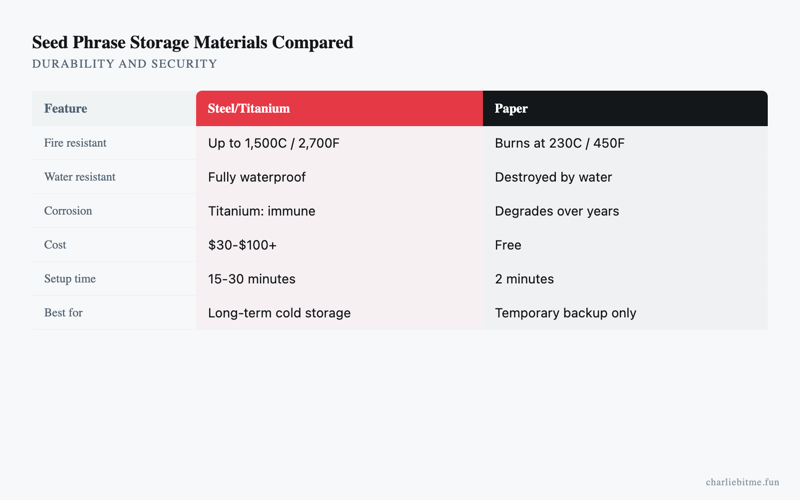
| Material | Fire Resistance | Water Resistance | Corrosion Resistance | Cost Range | Best For |
|---|---|---|---|---|---|
| Paper (handwritten) | Burns at ~230C | Destroyed | Degrades over years | Free | Temporary backup only |
| Laminated paper | Burns at ~230C | Good | Moderate (5-10 years) | Under $5 | Short-term water protection |
| Stainless steel (304) | Survives to ~1,400C | Excellent | Good | $25-$75 | Most users |
| Stainless steel (316) | Survives to ~1,400C | Excellent | Excellent (marine grade) | $50-$120 | Humid or coastal environments |
| Titanium (Grade 2) | Survives to ~1,670C | Excellent | Superior | $80-$200 | Maximum durability |
Popular steel backup products include the Cryptosteel Capsule, Billfodl, and BlockPlate. Each uses a different mechanism — sliding tiles, engraved letters, or center-punch stamps. The mechanism matters less than the grade of steel. Avoid cheap alloys that corrode.
My opinion: stainless steel 304 hits the best balance of cost and durability for most people. Titanium is overkill unless you live in a flood zone or store holdings above six figures.
Where Should You Store Your Seed Phrase Backup?
The location matters as much as the material. Your backup must survive natural disasters, theft, and your own forgetfulness. Spreading risk across two locations is the minimum standard for meaningful holdings.
Home storage options
A fireproof safe rated UL 72 Class 350 protects paper documents to 350F for one hour. That is not enough for a house fire, which reaches 600C at floor level. A steel seed phrase plate survives the fire directly, but the safe prevents casual theft. Use both together.
Never store your seed phrase in the same location as your hardware wallet. If a thief finds both, they drain your wallet in minutes.
Off-site storage options
A bank safe deposit box provides fire protection, flood protection, and theft protection. The downside: access is limited to banking hours, and in rare cases banks drill boxes during disputes. A second trusted location — a family member’s safe, a separate property — provides geographic redundancy.
Some users split their 24-word phrase using Shamir’s Secret Sharing (SSS) or a simpler 2-of-3 split scheme. With a 2-of-3 split, you create three shares, each containing 16 of 24 words. Any two shares reconstruct the full phrase. Store each share in a different location.
What Are the Most Common Seed Phrase Storage Mistakes?
The majority of seed phrase losses come from a small number of repeated mistakes. Every one of these has cost someone real money.
Taking a photo or screenshot. Your phone syncs to iCloud, Google Photos, or a compromised backup service. A single data breach exposes your phrase. Never digitize your seed phrase in any form — no photos, no text files, no password managers, no email drafts.
Storing it in a cloud service. Even encrypted cloud storage adds an attack surface you do not control. The encryption key might be derived from a password that gets phished.
Writing it on paper and forgetting where. Paper degrades. Ink fades. People move. A seed phrase written in a notebook in a desk drawer is one house cleaning away from the trash.
Telling someone else the words. No legitimate service, wallet company, or support team will ever ask for your seed phrase. Anyone who asks is attempting theft.
Not verifying the backup. According to Trezor’s recovery documentation, users should verify their backup by performing a test recovery on a fresh device within the first week. Most people skip this step and discover their backup is wrong only when they need it.
How Should You Test Your Seed Phrase Backup?
A backup you have never tested is not a backup. It is a hope. Testing confirms that you wrote every word correctly, in the correct order, and that your recovery process works end to end.
Step 1: Reset your hardware wallet or use a second device. Ledger, Trezor, and Keystone all support recovery from seed phrase during initial setup.
Step 2: Enter the seed phrase from your physical backup — not from memory, not from a digital copy. Use the steel plate or paper card you actually stored.
Step 3: Verify that the wallet generates the same receiving addresses. Send a small test transaction to confirm.
Step 4: Reset the test device and restore your original wallet. Test annually.
Read more about our verification standards in the how we research methodology page.
Can You Use a Passphrase as an Extra Layer of Protection?
Yes. BIP-39 supports an optional passphrase (sometimes called the “25th word”) that creates an entirely different set of wallet addresses from the same seed phrase. Even if someone finds your 24 words, they cannot access funds protected by the passphrase.
The tradeoff: if you forget the passphrase, those funds are gone permanently. There is no recovery. Store the passphrase separately from the seed phrase — ideally in a different physical location. This creates a natural 2-of-2 security model where a thief needs both your seed phrase and your passphrase.
For recovering funds sent to incorrect addresses — a different but related problem — see our guide on how to recover crypto sent to the wrong address.
Frequently Asked Questions
- Can I store my seed phrase in a password manager?
- No. Password managers are designed for credentials you change regularly, not for irreplaceable master keys. A compromised master password or a breach at the password manager company exposes your seed phrase. Use a physical backup on steel or titanium instead.
- How many copies of my seed phrase should I keep?
- Two physical copies stored in separate geographic locations is the minimum for meaningful holdings. More copies increase availability but also increase the number of locations a thief could target. Most users find two copies in two locations the right balance.
- Is it safe to engrave my seed phrase on metal myself?
- Yes, provided you use a manual punch set — not an electric engraver connected to a computer. Hand-stamped stainless steel is one of the most reliable methods. Products like the BlockPlate include alignment guides that make the process straightforward.
- What happens if my steel backup gets damaged in a fire?
- Grade 304 stainless steel survives temperatures up to approximately 1,400C. Residential fires typically peak between 600C and 1,100C. The plate may discolor but the stamped or engraved letters remain legible. Titanium offers even higher tolerance at 1,670C.
Sources
- BIP-39 Specification — Bitcoin Improvement Proposals (accessed when I last checked)
- Trezor — How to Back Up Your Seed (accessed when I last checked)
- Ledger — Recovery Phrase Best Practices (accessed when I last checked)
- Chainalysis — Lost Cryptocurrency Data (accessed when I last checked)
- Jameson Lopp — Metal Bitcoin Seed Storage Reviews (accessed when I last checked)
This article is for informational purposes only and does not constitute financial advice. Cryptocurrency involves significant risk. Always verify security practices against the latest documentation from your wallet manufacturer.