A multisig (multi-signature) wallet requires approval from multiple private keys before any transaction can execute, eliminating the single point of failure that makes standard crypto wallets vulnerable. A 2-of-3 multisig, for example, needs two out of three keyholders to sign every transaction. DAOs, businesses, family trusts, and security-conscious individuals use multisig wallets to protect large holdings. This guide covers how they work, when to use one, and how to set one up using Safe (formerly Gnosis Safe).
In This Article
Multisig wallets solve the fundamental tension in crypto custody: self-custody removes exchange risk but concentrates all risk in a single seed phrase. A multisig distributes that risk. For background on why self-custody matters, see our crypto wallet security best practices guide.
How Does a Multisig Wallet Work?
A multisig wallet is a smart contract that holds funds and requires a predefined number of authorized signers to approve any outgoing transaction. The “M-of-N” configuration means M signatures are needed out of N total authorized keys. No single keyholder can move funds alone, and losing one key does not lock out the wallet.
When a signer proposes a transaction, the other signers see the pending request in the multisig interface. They review the destination, amount, and data, then approve or reject. Once the threshold is met, the transaction executes on-chain. The entire approval process is transparent and auditable.
According to Safe’s documentation, their smart contract wallets secure over $100 billion in digital assets. The smart contract itself has been audited multiple times and has operated without a critical vulnerability since its deployment.
What Are the Most Common Multisig Configurations?
The three most common setups are 2-of-3 (personal security), 3-of-5 (organizational), and 4-of-7 (DAO governance). The right configuration depends on the number of parties involved, the value at stake, and how quickly you need to execute transactions.
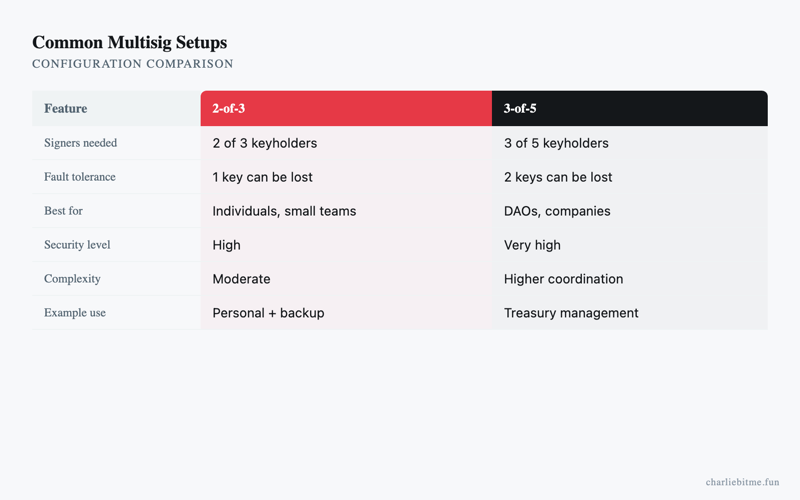
| Configuration | Best For | Key Loss Tolerance | Approval Speed | Security Level |
|---|---|---|---|---|
| 2-of-3 | Individuals, couples, small groups | Can lose 1 key | Fast — only 2 approvals needed | High |
| 3-of-5 | Small businesses, investment clubs | Can lose 2 keys | Moderate | Very high |
| 4-of-7 | DAOs, large organizations | Can lose 3 keys | Slow — coordination needed | Maximum |
| 2-of-2 | Joint accounts | Cannot lose any key | Both must agree | High (but fragile) |
A 2-of-3 configuration is the sweet spot for most individuals. You hold two keys yourself (on different devices, in different locations) and give the third to a trusted person or store it in a bank safe deposit box. You can transact normally with your two keys, and if you lose one, the backup signer plus your remaining key can recover access.
When Should You Use a Multisig Instead of a Standard Wallet?
Use a multisig when your holdings exceed what you can afford to lose to a single compromised device, a stolen seed phrase, or a moment of coercion. For individuals, a common threshold is anything above $10,000 to $50,000 in long-term holdings. For businesses handling customer funds, multisig is a minimum security standard.
Specific use cases where multisig is strongly recommended:
Business treasury management. No single employee should be able to drain the company’s crypto treasury. A 3-of-5 multisig with keys held by the CEO, CFO, and three board members ensures oversight.
Family inheritance planning. A 2-of-3 setup where you hold two keys and your estate attorney or trusted family member holds the third ensures your crypto is recoverable if something happens to you. This solves the problem of seed phrase storage for inheritance scenarios.
DAO governance. Decentralized organizations use multisig to manage shared treasuries. According to DeepDAO, the majority of DAO treasuries are held in Safe multisig wallets.
How Do You Set Up a Safe (Gnosis Safe) Multisig Wallet?
Go to app.safe.global, connect any Ethereum wallet as the first signer, add the other signer addresses, set the threshold, and deploy the multisig contract. The setup takes about 10 minutes and costs one gas fee for the contract deployment.
Step 1: Navigate to app.safe.global. Select the network (Ethereum, Arbitrum, Polygon, etc.). Connect your wallet — this will be your first signer.
Step 2: Click “Create New Safe.” Name it for your own reference (the name is stored locally, not on-chain).
Step 3: Add signer addresses. Enter the Ethereum addresses of each co-signer. Each signer needs their own wallet (hardware wallet recommended for security). Set the confirmation threshold — how many signers must approve.
Step 4: Review and deploy. The deployment costs gas (the deployer pays). Once confirmed on-chain, the multisig is live and can receive funds immediately.
Step 5: Test with a small amount first. Send a small transaction and have the required signers approve it to verify the workflow before depositing significant funds.
For maximum security, each signer should use a hardware wallet. If one signer uses a hot wallet and it gets compromised, the multisig threshold still protects the funds — but only if the remaining signers use secure key storage. Learn how to keep crypto safe across different exchange types in our exchange custody guide.
What Are the Limitations of Multisig Wallets?
Multisig wallets are slower for routine transactions, cost more gas (each approval is an on-chain transaction), and require coordination among signers who must all be available. They also do not natively support every blockchain — Safe operates primarily on EVM-compatible chains.
If one signer becomes unresponsive and you are running a 3-of-5 setup, you can still operate. But if two signers become unresponsive, you are locked out until they respond. Social recovery wallets (like Argent) offer an alternative approach where trusted contacts can help recover access without being full signers.
My opinion: for holdings under $10,000, the overhead of a multisig is usually not worth it. A hardware wallet with a properly secured seed phrase backup provides sufficient security. Above $50,000 in long-term holdings, multisig should be the default. The small inconvenience of coordinating signatures is trivial compared to the risk of single-key compromise.
Read about how we verify security recommendations in our research methodology.
Frequently Asked Questions
- Does a multisig wallet cost more to use than a regular wallet?
- Yes. Each approval transaction requires gas. A 2-of-3 multisig transaction costs roughly 2-3x more gas than a standard wallet transaction because multiple on-chain signatures are needed. The contract deployment also costs gas.
- Can I use a multisig for Bitcoin?
- Yes. Bitcoin natively supports multisig through P2SH (pay-to-script-hash) addresses. Tools like Sparrow Wallet, Electrum, and Caravan (by Unchained) support Bitcoin multisig. The approach differs from Ethereum smart contract multisig but achieves the same result.
- What happens if I lose one key in a multisig?
- In a 2-of-3 setup, losing one key still lets you transact with the remaining two. You should immediately create a replacement key and update the multisig signers (which requires the existing threshold of approvals).
Sources
- Safe (formerly Gnosis Safe) — Documentation — accessed when I last checked
- DeepDAO — DAO Treasury and Governance Data — accessed when I last checked
- Safe Developer Documentation — accessed when I last checked
This article is for informational purposes only and does not constitute financial advice. Cryptocurrency investments carry significant risk. Consult a qualified financial advisor before making investment decisions.