Recovering cryptocurrency sent to the wrong address depends entirely on the type of mistake, the blockchain involved, and whether the recipient address belongs to an entity you can contact. Sending tokens to a valid address on the correct chain but owned by someone else is typically irrecoverable. Sending to the wrong chain or a contract address sometimes has recovery paths. Acting fast and understanding your specific scenario determines your outcome.
In This Article
- What Are the Most Common Wrong-Address Scenarios?
- How Do You Recover Crypto Sent to the Wrong Network?
- Can Exchanges Recover Crypto Sent to the Wrong Address?
- What Should You Do If You Sent Crypto to an Unknown Address?
- How Do You Protect Yourself From Clipboard Hijacking?
- Frequently Asked Questions
What Are the Most Common Wrong-Address Scenarios?
Wrong-address errors fall into four categories, each with different recovery odds. The most common is sending tokens to the correct blockchain but the wrong recipient address — for example, pasting an old exchange deposit address that has been rotated. The second is sending tokens to the right address but on the wrong network — like sending ETH to a Binance Smart Chain address. The third involves sending to a smart contract address that was not designed to receive that token. The fourth is a typo in the address itself.
Address checksums in modern wallets have nearly eliminated the typo scenario. Ethereum uses EIP-55 mixed-case checksums. Bitcoin uses Bech32 encoding with built-in error detection. If you alter even one character, the wallet rejects the address as invalid. The real risk today comes from clipboard hijacking malware and copy-paste errors between similar-looking addresses.
| Scenario | Example | Recovery Possible? | Action Required |
|---|---|---|---|
| Wrong recipient, correct chain | Sent ETH to someone else’s Ethereum address | Only if recipient cooperates | Contact recipient directly |
| Wrong network, same address format | Sent ETH to your BSC address | Usually yes | Import private key on correct chain |
| Sent to smart contract | Sent tokens to a token contract address | Rarely — depends on contract code | Contact protocol team |
| Sent to exchange, wrong network | Sent ERC-20 USDT on Tron to Ethereum deposit | Varies by exchange | Submit support ticket |
| Sent to non-existent address | Manually typed an invalid address | Address rejected by wallet — no send occurs | None needed |
| Sent wrong token to exchange | Sent unsupported ERC-20 to exchange | Often yes, with fee | Submit support ticket |
How Do You Recover Crypto Sent to the Wrong Network?
Sending crypto to the wrong network is the most recoverable category of wrong-address errors. EVM-compatible chains (Ethereum, BNB Chain, Polygon, Arbitrum, Avalanche) share the same address format. If you sent ETH to your own address but on the wrong EVM chain, your private key controls that address on every EVM chain. Import your private key or seed phrase into a wallet that supports the chain where the funds landed.
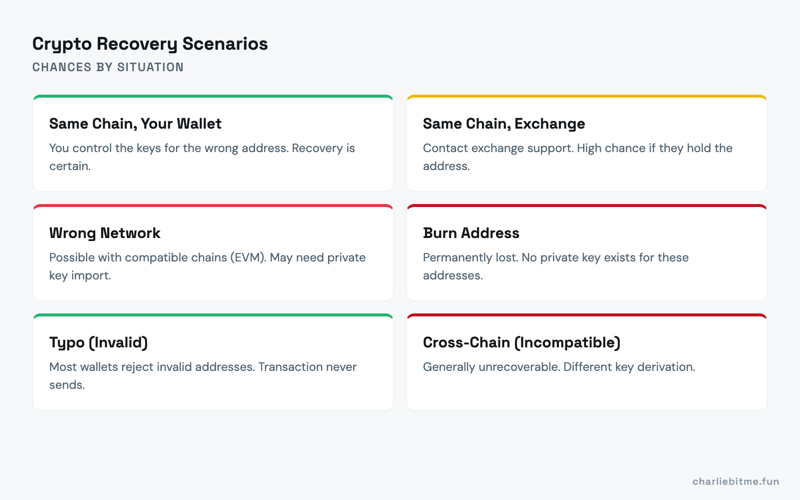
For MetaMask users, this means adding the correct network’s RPC endpoint. Go to Settings, Networks, and add the chain where your tokens are. Your address — and your tokens — will appear. This works because your Ethereum private key derives the same address on all EVM chains.
Non-EVM chains (Bitcoin, Solana, Cosmos, Cardano) use different address formats. Sending Bitcoin to a Solana address is not possible because the address formats are incompatible — wallets reject the transaction before it broadcasts. Cross-chain mistakes between non-EVM networks are effectively impossible under normal wallet usage.
For general best practices on avoiding these mistakes, see our wallet security guide.
Can Exchanges Recover Crypto Sent to the Wrong Address?
If you sent tokens to an exchange deposit address on the wrong network, the exchange may be able to recover the funds. Binance, Coinbase, Kraken, and most major exchanges have recovery processes for common cross-network deposit errors. According to Binance’s support documentation, they charge a recovery fee (typically $50-200 depending on the token and chain) and the process takes 2-4 weeks.
The exchange must control the private key for the deposit address on the receiving chain. If the exchange uses the same hot wallet infrastructure across EVM chains — which most major exchanges do — recovery is technically straightforward. The fee covers manual processing by their operations team.
Smaller exchanges and DEXs generally cannot recover cross-chain deposit errors. A DEX has no custodial control over addresses. If you sent tokens to a DEX router contract on the wrong chain, recovery depends entirely on whether the contract has a recovery function — most do not.
Always verify the correct deposit address and network before sending. Compare the first and last 6 characters of the address after pasting. Confirm the network matches. Send a small test transaction first for any transfer above $1,000. These habits prevent the vast majority of wrong-address errors. Our guide on setting up a hardware wallet covers additional verification steps for high-value transfers.
What Should You Do If You Sent Crypto to an Unknown Address?
If you sent crypto to a valid address that you do not control and do not recognize, your recovery options are limited. Blockchain transactions are irreversible by design. There is no “chargeback” mechanism, no customer service, and no central authority that can reverse the transfer.
Start by identifying the recipient address. Check the address on a block explorer (Etherscan for Ethereum, BscScan for BNB Chain, Solscan for Solana). Look at the address’s transaction history. If it belongs to a known entity — an exchange, a protocol, or a labeled wallet — you may be able to contact them. Etherscan and Arkham Intelligence label many known addresses.
If the address is unlabeled and has no transaction history, the funds are effectively lost. Nobody controls an address that has never transacted — it may be a burned address or an address derived from an unknown key. If the address shows activity, someone controls it, but you have no mechanism to compel them to return the funds.
Report the loss to your local law enforcement and file a complaint with the FBI’s IC3 (Internet Crime Complaint Center) if the amount is significant. While recovery through law enforcement is rare for individual crypto transfers, establishing a paper trail is important for tax deduction purposes and insurance claims.
How Do You Protect Yourself From Clipboard Hijacking?
Clipboard hijacking malware monitors your clipboard for cryptocurrency addresses and replaces them with an attacker’s address when you paste. According to cybersecurity firm Kaspersky, clipboard hijackers were found in over 10,000 malware samples targeting crypto users in 2023 alone.
The defense is verification after pasting. Always compare the pasted address to the source — check at least the first 8 and last 8 characters. Use hardware wallets that display the full destination address on their screen for physical verification before signing. Ledger and Trezor both require on-device address confirmation.
Keep your operating system and browser updated. Run reputable antivirus software. Avoid installing browser extensions from unknown developers. Use a dedicated device or browser profile for crypto transactions. These practices are covered in detail in our seed phrase storage guide and our research methodology page.
This article is for informational purposes only and does not constitute financial advice. Cryptocurrency transactions are irreversible. Always verify addresses before sending and use test transactions for large transfers.
Frequently Asked Questions
- Can blockchain developers reverse a wrong transaction?
- No. Blockchain transactions are immutable by design. Even core developers cannot reverse individual transactions without a network-wide hard fork, which has only happened once in crypto history (the 2016 Ethereum DAO hack) and required community consensus.
- Is crypto sent to a burn address recoverable?
- No. Burn addresses (like Ethereum’s 0x000…dead) have no known private key. Tokens sent to burn addresses are permanently destroyed. This is by design and is used intentionally by projects to reduce supply.
- How long do I have to recover crypto from a wrong address?
- There is no time limit on the blockchain side — the funds exist at that address indefinitely. However, if the recipient is an exchange, their internal policies may have deadlines for recovery requests. File support tickets immediately.
- Can I claim a tax deduction for crypto lost to a wrong address?
- In the United States, the IRS does not allow casualty loss deductions for personal crypto losses outside of federally declared disasters. However, some tax professionals argue for deductions under specific circumstances. Consult a qualified crypto tax advisor for your situation.