When a cryptocurrency exchange goes bankrupt, your deposits become part of the bankruptcy estate. You are an unsecured creditor — last in line behind secured creditors, employees, and tax authorities. The FTX collapse proved this in devastating detail: customers waited over two years for partial recovery. The only reliable protection is self-custody. If you do not hold your private keys, you do not truly own your cryptocurrency.
In This Article
- What Happens Legally to Your Crypto When an Exchange Files Bankruptcy?
- How Did the FTX Bankruptcy Play Out for Customers?
- What Is the Difference Between Custodial Risk on Exchanges?
- What Is Proof of Reserves and Does It Protect You?
- How Does Self-Custody Protect Against Exchange Bankruptcy?
- Frequently Asked Questions
- Sources
What Happens Legally to Your Crypto When an Exchange Files Bankruptcy?
Under U.S. bankruptcy law, customer deposits on a crypto exchange are not segregated the way brokerage accounts are protected under SIPC. When FTX filed Chapter 11 bankruptcy in November 2022, the court classified customer deposits as property of the bankruptcy estate. Customers became unsecured creditors with claims against the estate — not owners of specific assets.
This classification has enormous consequences. Secured creditors (those with collateral-backed claims) get paid first. Then administrative costs, employee wages, and tax obligations. Unsecured creditors receive whatever remains, distributed pro rata. In many bankruptcies, unsecured creditors recover pennies on the dollar.
According to court filings in the FTX case, the estate identified over $8 billion in customer claims. The recovery process involved liquidating assets, pursuing clawback lawsuits against insiders and recipients of preferential transfers, and negotiating with creditor committees. FTX customers were eventually offered recovery amounts based on asset values at the bankruptcy filing date — not at current market prices — a critical distinction that cost many customers significant gains during the subsequent bull market.
How Did the FTX Bankruptcy Play Out for Customers?
FTX filed Chapter 11 on November 11, 2022, after a liquidity crisis revealed that customer funds had been misappropriated and lent to sister company Alameda Research. At the time, Bitcoin traded around $16,000 and Ethereum around $1,200.
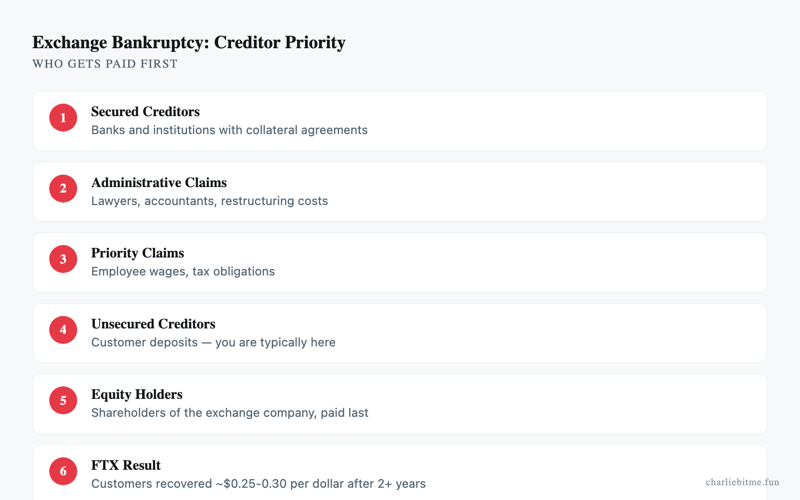
The bankruptcy plan, confirmed by Judge John Dorsey in the U.S. Bankruptcy Court for the District of Delaware, offered customers recovery based on petition-date prices. A customer who held 1 Bitcoin at filing received a cash claim valued at roughly $16,000 — even though Bitcoin had risen above $60,000 by the time distributions began. This valuation method is standard in U.S. bankruptcy law, but it meant customers missed the entire recovery rally.
According to Reuters reporting, the estate managed to recover substantial assets through litigation and sales, ultimately offering most small creditors (claims under $50,000) recovery at or near 100% of petition-date value. Larger creditors received partial recovery. No customer was fully compensated at current market prices.
What Is the Difference Between Custodial Risk on Exchanges?
Not all exchanges carry equal risk. The key variables are regulation, proof of reserves, insurance coverage, and corporate governance.
| Factor | Lower Risk (Regulated) | Higher Risk (Unregulated) |
|---|---|---|
| Regulation | Licensed in U.S., EU, or Japan (Coinbase, Kraken, Bitstamp) | Offshore, no clear regulatory home (some DEX wrappers) |
| Proof of Reserves | Third-party attested, on-chain verifiable | Self-reported or absent |
| Asset Segregation | Customer assets held separately from operating funds | Commingled with company treasury |
| Insurance | Crime/cybersecurity insurance, partial FDIC on USD | No insurance coverage |
| Financial Audits | Regular audits by Big 4 or comparable firms | No independent audits |
| Corporate Structure | Public company or regulated entity with board oversight | Opaque ownership, no public governance |
Coinbase, as a publicly traded U.S. company (NASDAQ: COIN), operates under SEC reporting requirements and state money transmitter licenses. Customer crypto assets are disclosed as a line item. Coinbase has stated that customer assets would not be treated as company property in bankruptcy, though this has not been legally tested.
The lesson from FTX: regulatory status and corporate transparency are not guarantees, but they are the best predictive signals available. FTX operated from the Bahamas with minimal regulatory oversight, no independent board, and no audited financial statements.
What Is Proof of Reserves and Does It Protect You?
Proof of reserves (PoR) is a cryptographic audit that verifies an exchange holds sufficient assets to cover customer deposits. After the FTX collapse, most major exchanges implemented some form of PoR. The quality varies significantly.
A robust PoR system uses a Merkle tree to cryptographically prove that your individual account balance is included in the total reserves without revealing other customers’ data. Binance, Kraken, and OKX publish regular PoR reports.
However, PoR has limitations. It proves assets exist at a specific moment in time — not that they were not borrowed for the snapshot. It does not reveal liabilities. An exchange could hold $10 billion in customer assets but owe $15 billion in debts, and PoR would still show full reserves. Only a complete financial audit, including liabilities, provides true solvency verification.
For best practices on protecting your assets beyond exchange custody, see our crypto wallet security guide. We also cover the specific debate about keeping crypto on exchanges and how to use multisig wallets for enhanced self-custody.
How Does Self-Custody Protect Against Exchange Bankruptcy?
Self-custody eliminates exchange counterparty risk entirely. When you hold cryptocurrency in a wallet where you control the private keys, no bankruptcy proceeding can touch your assets. They are not part of any corporate balance sheet or estate.
Hardware wallets from Ledger and Trezor store private keys offline. Software wallets like MetaMask and Rabby store keys locally. In either case, the wallet is not custodial — no third party can freeze, seize, or lose your funds through mismanagement.
The trade-off is responsibility. Self-custody means you are solely responsible for your seed phrase backup, device security, and transaction verification. Losing your seed phrase means permanent loss of funds with no customer support to call. This is a real risk — but it is a risk you control, unlike exchange solvency risk which you cannot control or predict. Read our research methodology for how we evaluate exchange and custody risks.
Frequently Asked Questions
- Is crypto on exchanges insured like bank deposits?
- No. FDIC insurance covers U.S. dollar deposits at banks, not cryptocurrency. Some exchanges insure USD balances held in partner banks, but crypto balances are not covered by any government insurance program. Private insurance policies exist but cover only specific loss scenarios like theft, not insolvency.
- Can I get my crypto back if an exchange is hacked?
- It depends on the exchange and the severity of the hack. Major exchanges like Binance maintain insurance funds (SAFU) to cover hack losses. Smaller exchanges may not have reserves to compensate users. In the worst case, a hack leads to insolvency and bankruptcy.
- How long does a crypto exchange bankruptcy take to resolve?
- FTX took over two years from filing to initial distributions. Mt. Gox, which collapsed in 2014, took nearly a decade to begin creditor repayments. Crypto bankruptcies involve complex asset tracing and litigation that extends timelines far beyond traditional cases.
- Should I keep any crypto on an exchange?
- Keep only what you need for active trading on the exchange. Move long-term holdings to self-custody. A reasonable rule: keep no more than 10-20% of your portfolio on any single exchange, and diversify across platforms if you trade actively.
Sources
- FTX Bankruptcy Case — Kroll Restructuring — kroll.com (checked when I last reviewed)
- Reuters — FTX Creditor Recovery — reuters.com
- Binance Proof of Reserves — binance.com
- Kraken Proof of Reserves — kraken.com
This article is for informational purposes only and does not constitute financial advice. Cryptocurrency held on exchanges is subject to counterparty risk. Consider self-custody for long-term holdings.